Trump open to trilateral talks with Putin and Xi on Ukraine, Russia says peace talks possible in November
Reported by
A dot shows how that piece reads — Prism rates articles, not outlets, and shows the words behind each placement below. No dot means the piece isn’t rated. How the ratings work
What happened
The account the coverage agrees on, with contested figures attributed rather than asserted. This is not one of the five framings below — it is the ground they all stand on.
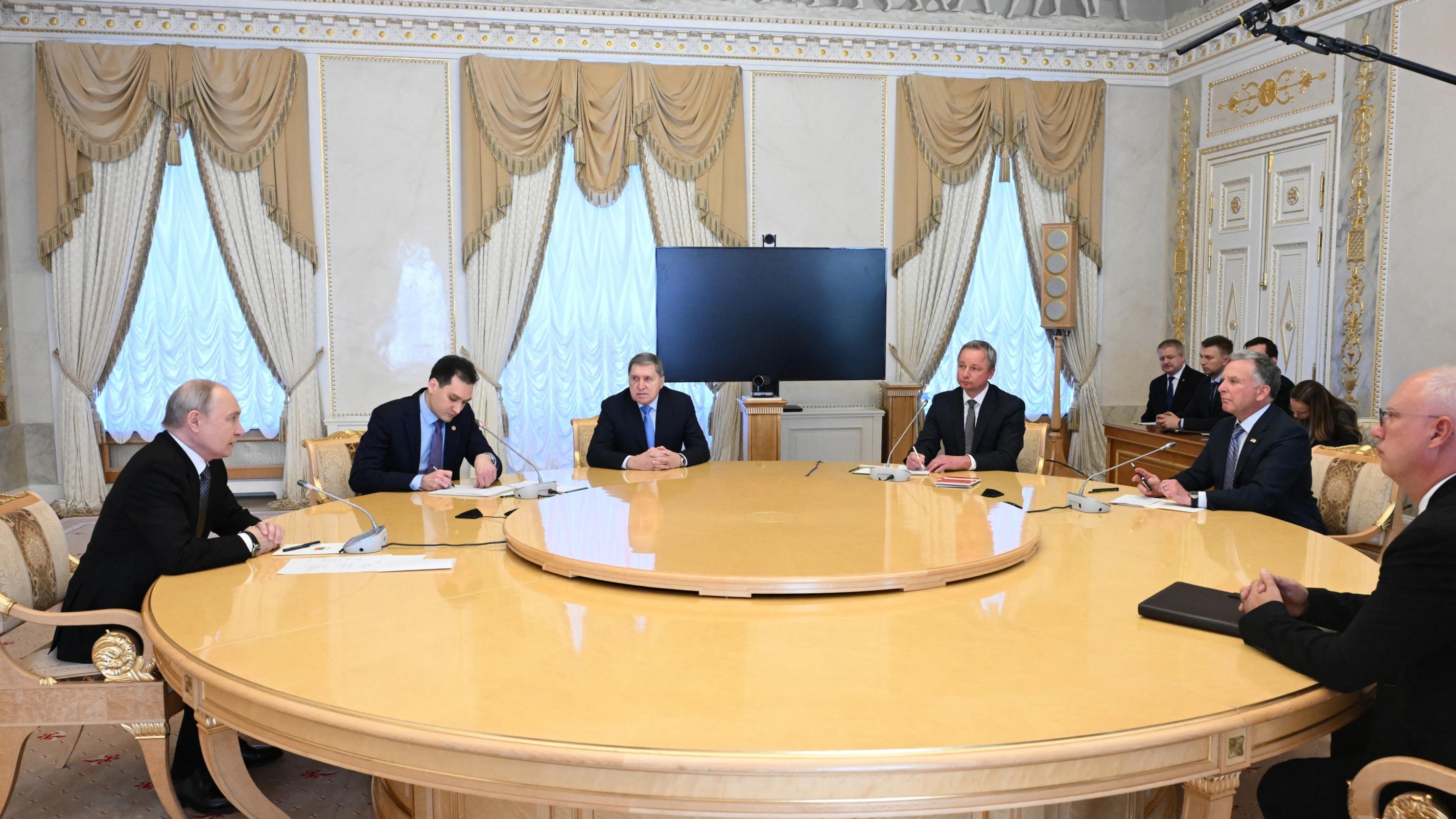
Steve Witkoff, a Trump adviser, met with Vladimir Putin in St. Petersburg for nearly three hours on Wednesday. Russia's Kremlin spokesperson said proposals transmitted after Oslo talks "don't contain much." Ukrainian President Zelensky indicated openness to ending the war with frozen front lines, conditional on U.S. and European security guarantees. Coverage reflects ongoing diplomatic efforts and uncertainty about U.S. commitment to Ukraine amid Trump administration focus on Russia negotiations.
Developing story · 2 chapters
- Trump says he is open to trilateral summit with Putin and Xi, focusing on denuclearization and criticizing Zelenskyy
- Trump open to trilateral talks with Putin and Xi on Ukraine, Russia says peace talks possible in Novemberyou are here
How each side framed the previous chapter
Compare these with the five framings below to see what moved as the story developed — and what each side kept saying regardless.
Left
Trump is actively undermining Ukraine by proposing talks that exclude it, signaling he intends to pressure Kyiv into capitulation to serve his geopolitical interests with Russia and China. His willingness to negotiate with Putin while attacking Zelenskyy reveals how his administration has shifted from supporting democracy against authoritarianism to accommodating autocrats. This represents a fundamental betrayal of America's alliance commitments and the principle of standing against aggression.
Center-left
Trump's proposal to hold talks on Ukraine without Ukraine present is a problematic approach that could weaken Kyiv's negotiating position and send the wrong signal to Putin. His criticism of Zelenskyy and suggestion for alternative Ukrainian negotiators appears designed to create leverage over Kyiv rather than strengthen the West's position. While diplomatic engagement with major powers can be valuable, excluding the country most affected by the conflict undermines legitimate Ukrainian interests and risks a forced settlement.
Center
Trump's openness to a summit with Putin and Xi reflects a realpolitik approach to managing great-power competition, but the exclusion of Ukraine from talks affecting its fate raises serious practical concerns. While denuclearization discussions between the nuclear powers merit consideration, divorcing those from Ukraine's security needs creates tensions between different diplomatic objectives. The deteriorating relationship with Zelenskyy complicates both immediate aid flows and long-term settlement prospects; some negotiating pressure may be necessary, but it requires careful calibration to avoid appearing to abandon an ally.
Center-right
Trump is right to pursue diplomatic engagement with Russia and China rather than endless military aid to Ukraine. A trilateral summit addressing nuclear weapons is a legitimate strategic priority for the U.S., and Ukraine should ultimately accept a negotiated settlement rather than continue an unwinnable war. Zelenskyy's resistance to compromise and demands for unconditional Western support have become counterproductive; Trump's suggestion that Ukraine needs different leadership reflects the reality that current approaches are not working. Direct talks between the major powers are how serious diplomacy happens.
Right
Trump is correctly prioritizing American interests by engaging directly with Putin and Xi rather than being drawn into an open-ended commitment to Ukraine. The U.S. has spent enormous resources on a peripheral conflict while neglecting its own needs and alienating Russia, which should be a natural partner against China. Zelenskyy has become a liability, demanding ever more American support while refusing reasonable compromises. Trump's willingness to talk to the actual decision-makers without Ukraine's obstruction is the clear-headed diplomacy America needs.
How the spectrum reads this story
The same event, summarised as five points on the political spectrum would each tend to frame it. These are generated by an AI model and are a starting point, not the last word.
Left
The Trump administration is abandoning Ukraine to pursue rapprochement with Russia, prioritizing geopolitical realignment over Ukraine's sovereignty. Witkoff's visit to Putin signals the White House is prepared to accept Russian territorial gains and weaken Ukraine's negotiating position by cutting support. This reversal of U.S. policy rewards aggression and threatens the post-war order, while Europe lacks the resources to sustain Ukraine alone—a situation the administration appears willing to exploit.
No article in this story reads this way. This is how the position tends to frame events like it — written by a model, not quoted from anyone.
Center-left
The Trump administration's shift toward direct talks with Russia creates real risks for Ukraine's position. While diplomatic engagement with Moscow isn't inherently wrong, the administration's apparent eagerness to broker a deal and reduced emphasis on Ukrainian agency suggest the U.S. may pressure Kyiv into unfavorable terms. Europe needs to prepare to increase its own support, but Ukraine requires sustained American backing to avoid accepting a settlement that validates Russian conquest.
Drawn from 3 articles placed here, below.
Center
Diplomatic channels are opening between Washington and Moscow, which could eventually produce a settlement, but the process carries significant risks. Zelensky's conditional openness to a frozen conflict suggests room for negotiation, yet Russia's dismissal of recent proposals and Trump's apparent eagerness to deal create misaligned expectations. The real question is whether mediation leads to a sustainable arrangement or simply allows Russia to consolidate gains while the U.S. reduces its role. Europe's capacity matters, but American security guarantees remain central to any agreement's credibility.
Drawn from 4 articles placed here, below.
Center-right
Direct U.S.-Russia talks represent a sensible alternative to open-ended military support for Ukraine. Trump's willingness to engage Moscow diplomatically could break the stalemate and reduce American costs while encouraging a negotiated settlement. Zelensky's openness to frozen front lines shows negotiation is possible if the U.S. and Europe provide security assurances. Rather than an abandonment, this reflects a pragmatic shift toward sustainable commitments—avoiding costly entanglement while maintaining deterrence through conditional support.
No article in this story reads this way. This is how the position tends to frame events like it — written by a model, not quoted from anyone.
Right
The Trump administration is correctly recalibrating U.S. interests away from unlimited Ukraine support toward direct engagement with Russia as a counterweight to China and other threats. Witkoff's talks signal willingness to accept a settlement based on current positions, reducing American military expenditure and entanglement in a European conflict. Zelensky's conditional openness proves negotiation is possible. The U.S. should not allow itself to be drawn into guaranteeing European security indefinitely—Europe must take primary responsibility for its own defense.
Drawn from 1 article placed here, below.
Hear two viewpoints debate it
Pick two viewpoints and Prism writes a short, six-turn exchange about this story in each one’s own voice — steel-manned, no winner declared. Each pairing is written once and then saved for every reader. The voices are AI syntheses of a tradition, not real people.
New pairing — Prism will write it now.
How each outlet covered it
Where Prism places each piece — not the outlet in general — with the words from that piece that put it there, and the photograph the outlet chose. Picking a photo is a framing decision too.
 TimeThis piece reads center-left
“Renewed military conflict before or after the midterms won't resolve”
Read the original Politiconot ratedRead the original
 VoxThis piece reads center-left
“Is the US abandoning Ukraine?”
FramingThe headline frames administrative shifts as potential abandonment, language that presumes the worst interpretation rather than describing the diplomatic maneuvers themselves.
Read the original Foreign PolicyThis piece reads center-left
“The White House appears increasingly focused on bolstering ties with Russia”
Word choiceUses 'bolstering ties' where the facts show engagement in specific talks; the phrase implies a broader strategic reorientation beyond what the snippets establish.
Read the original- Le FigaroThis piece reads center
“détaillée et franche”
FramingReports Russia's assessment of proposals in direct quotation from Kremlin sources, allowing readers to see Russia's evaluation without editorial framing of its plausibility.
Read the original - The Straits TimesThis piece reads center
“Iranian officials have repeatedly spoken about the distrust”
Read the original  Just the NewsThis piece reads center
“open to ending war with Russia with front lines frozen”
Read the original RedStateThis piece reads right
“Rubio Torches Zelensky After Ukrainian Government Insults”
Word choiceUses sharply adversarial language—'Torches' and 'Insults'—to frame the relationship as confrontational, where other outlets describe diplomatic discussions more neutrally.
Read the original
Placements are generated by an AI model from each article’s own headline and summary, and every quotation above is checked to be a real substring of that article before it is published. How this is done
Prism is free and carries no advertising. Support it if it was useful.