Trump and Xi extend two-month trade truce during state visit summit
Reported by
A dot shows how that piece reads — Prism rates articles, not outlets, and shows the words behind each placement below. No dot means the piece isn’t rated. How the ratings work

What happened
The account the coverage agrees on, with contested figures attributed rather than asserted. This is not one of the five framings below — it is the ground they all stand on.
President Donald Trump hosted Chinese President Xi Jinping at the White House on September 24, 2026, for a state summit. The two leaders discussed AI, trade, Taiwan, and Iran. They agreed to extend the Busan Agreement, creating a two-month trade truce. Multiple outlets reported that the summit featured elaborate ceremony and symbolism but produced no announced breakthroughs on major issues. Finance Minister Satsuki Katayama said Japan would continue coordinating with U.S. Treasury Secretary Scott Bessent on currency matters.
How the spectrum reads this story
The same event, summarised as five points on the political spectrum would each tend to frame it. These are generated by an AI model and are a starting point, not the last word.
Left
Trump's summit with Xi revealed the fundamental problem with treating major geopolitical and economic conflicts as personal diplomatic theater. The pageantry masked the absence of any serious structural agreements on trade, AI dominance, Taiwan's status, or regional security. A two-month truce on tariffs is window-dressing that leaves working people exposed to the same volatility and corporate profit-chasing that defined the trade war. Without addressing the underlying power imbalances and the race-to-the-bottom dynamics of global capitalism, such summits serve only to reassure markets while kicking the real problems down the road.
Center-left
The Trump-Xi meeting illustrates both the importance and the limitations of high-level diplomacy. While the ceremonial aspects and personal relationship-building have value, the lack of concrete progress on trade, technology competition, and regional security concerns is disappointing. A two-month extension of the Busan Agreement buys time but doesn't resolve the structural tensions between the world's two largest economies. Substantive negotiations on tariffs, AI governance, and Taiwan require serious technical work and good-faith commitment beyond state visits—areas where this summit fell short.
Center
The summit served its symbolic purpose in re-establishing high-level communication between Washington and Beijing after period of tension, which has genuine diplomatic value. However, neither side appears ready to make the concessions a major deal would require, so the two-month trade extension is a pragmatic holding pattern. The elaborate ceremony suggests both leaders want to project strength to their domestic audiences while quietly buying negotiating time. Whether this eventually leads to a substantive agreement or simply delays inevitable confrontation remains unclear, but keeping lines of communication open is preferable to escalation.
Center-right
Trump's personal diplomacy with Xi demonstrates the value of direct leader-to-leader engagement, though results have been modest. The two-month trade truce provides breathing room for supply chains and businesses, and both sides' agreement to discuss issues like AI and Taiwan represents at least a willingness to talk. However, fundamental disagreements on trade practices, technology transfer, and regional influence remain unresolved. More clarity on Trump's actual trade objectives and red lines—beyond the ceremonial aspects—is needed before assessing whether this summit genuinely advances American interests or merely postpones necessary confrontation.
Right
Trump brought appropriate pageantry and strength to the negotiating table, treating Xi as a peer while refusing to be pushed around. The decision to extend rather than escalate the trade conflict shows strategic patience—holding firm on core American interests while avoiding unnecessary economic disruption. However, the lack of concrete commitments from China on trade practices, intellectual property theft, and technology transfer suggests Beijing remains unwilling to seriously address long-standing grievances. The real test will be whether Trump uses the two-month window to negotiate from a position of strength or allows it to become another missed opportunity to reshape an unfair trading relationship.
Hear two viewpoints debate it
Pick two viewpoints and Prism writes a short, six-turn exchange about this story in each one’s own voice — steel-manned, no winner declared. Each pairing is written once and then saved for every reader. The voices are AI syntheses of a tradition, not real people.
New pairing — Prism will write it now.
How each outlet covered it
Where Prism places each piece — not the outlet in general — with the words from that piece that put it there, and the photograph the outlet chose. Picking a photo is a framing decision too.
- BloombergThis piece reads center-left
“heavy on pageantry and platitudes but light on substantive”
What's left outAdds detail about Trump's attention being divided by other concerns, a criticism absent from other outlets' accounts of the summit.
Read the original  The GuardianThis piece reads center-left
“went big on style but lacked substance”
Word choiceFrames the event with a coined term in the headline that characterizes it as entertainment disguised as diplomacy, a more skeptical framing than outlets calling it heavy on 'symbolism' or 'pageantry.'
Read the original- The Japan Timesnot ratedRead the original
/file/attachments/2998/14316726_749281.jpg)

 VoxThis piece reads center
“rolled out the literal red carpet”
FramingThe headline suggests a domestic opinion shift, while other outlets focus on the summit's diplomatic outcome or lack thereof—a different angle on what the event signals.
Read the original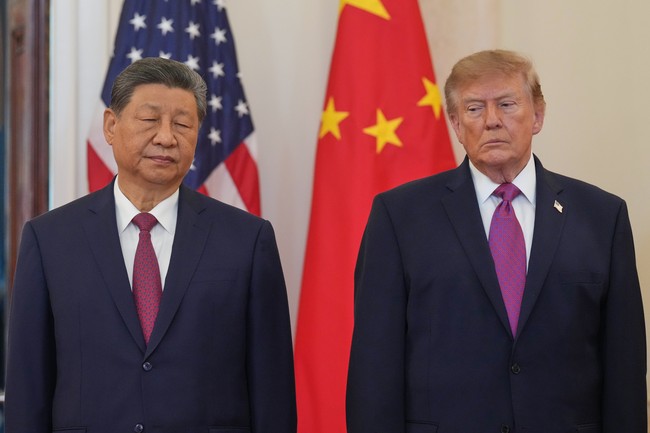
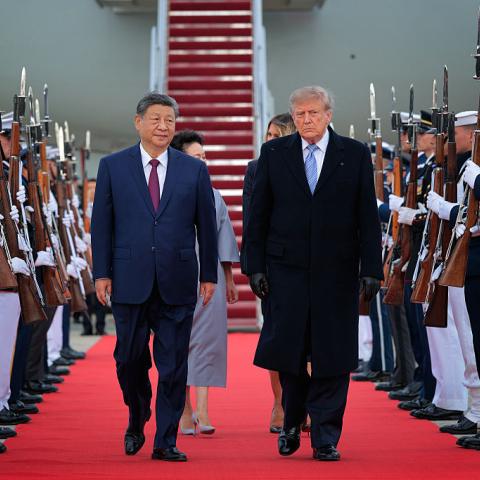 Just the NewsThis piece reads center-right
“two-month trade truce buys time for a bigger deal”
Word choiceUses the leaders' own diplomatic language in quotation marks; other outlets paraphrase or describe the talks more neutrally without highlighting the specific framing both sides offered.
Read the original
Placements are generated by an AI model from each article’s own headline and summary, and every quotation above is checked to be a real substring of that article before it is published. How this is done
Prism is free and carries no advertising. Support it if it was useful.