Supreme Court upholds New Hampshire's ban on student ID voting in November elections
Reported by
A dot shows how that piece reads — Prism rates articles, not outlets, and shows the words behind each placement below. No dot means the piece isn’t rated. How the ratings work

What happened
The account the coverage agrees on, with contested figures attributed rather than asserted. This is not one of the five framings below — it is the ground they all stand on.
The Supreme Court on Thursday granted an emergency application by New Hampshire Secretary of State David Scanlan, allowing the state to enforce a directive prohibiting the use of student IDs in elections. Justice Ketanji Brown Jackson dissented alone. The ruling overturned a lower court decision that had blocked the ban ahead of the November midterm elections. The Republican National Committee had backed the state's position.
How the spectrum reads this story
The same event, summarised as five points on the political spectrum would each tend to frame it. These are generated by an AI model and are a starting point, not the last word.
Left
The Supreme Court sided with Republicans to suppress voting access by blocking student IDs—a primary form of identification for young voters—just weeks before midterms. This decision reflects how the court's conservative majority enables voter suppression under the guise of election administration, disproportionately affecting younger and more Democratic-leaning voters who rely on student identification.
No article in this story reads this way. This is how the position tends to frame events like it — written by a model, not quoted from anyone.
Center-left
The Supreme Court's decision to allow New Hampshire's ban on student IDs raises concerns about voting access, particularly for younger voters who predominantly carry student IDs. While courts typically defer to states on election rules, this ban may reduce turnout among a key demographic and warrants scrutiny about whether legitimate election security concerns justify restricting a commonly held form of ID.
Drawn from 2 articles placed here, below.
Center
The Supreme Court faced a genuine tension between two principles: respecting state authority over elections and ensuring voting access. The court chose to defer to the state's judgment and avoid changing election rules close to voting day—a reasonable but not costless choice. Whether student IDs pose a genuine fraud risk or whether the ban will meaningfully affect turnout remains disputed.
Drawn from 3 articles placed here, below.
Center-right
The Supreme Court correctly allowed New Hampshire to enforce reasonable election integrity measures by banning student IDs, which can be issued to non-residents and lack reliable verification mechanisms. States have legitimate authority to set voter ID standards, and the court properly refused to let federal judges rewrite election rules at the last minute in response to partisan challenges.
Drawn from 1 article placed here, below.
Right
The Supreme Court appropriately upheld New Hampshire's authority to require reliable identification for voting. Student IDs are problematic for election security because they are issued to non-residents and lack the verification standards of other forms of ID. The decision properly rejected judicial overreach and protected states' constitutional power to regulate their own elections without federal courts imposing last-minute rule changes.
No article in this story reads this way. This is how the position tends to frame events like it — written by a model, not quoted from anyone.
Hear two viewpoints debate it
Pick two viewpoints and Prism writes a short, six-turn exchange about this story in each one’s own voice — steel-manned, no winner declared. Each pairing is written once and then saved for every reader. The voices are AI syntheses of a tradition, not real people.
New pairing — Prism will write it now.
How each outlet covered it
Where Prism places each piece — not the outlet in general — with the words from that piece that put it there, and the photograph the outlet chose. Picking a photo is a framing decision too.
- Courthouse NewsThis piece reads center-left
“GOP officials' student ID voting ban”
FramingAttributes the ban specifically to GOP officials rather than to the state directive, emphasizing partisan authorship where other outlets name the state or its election official.
Read the original 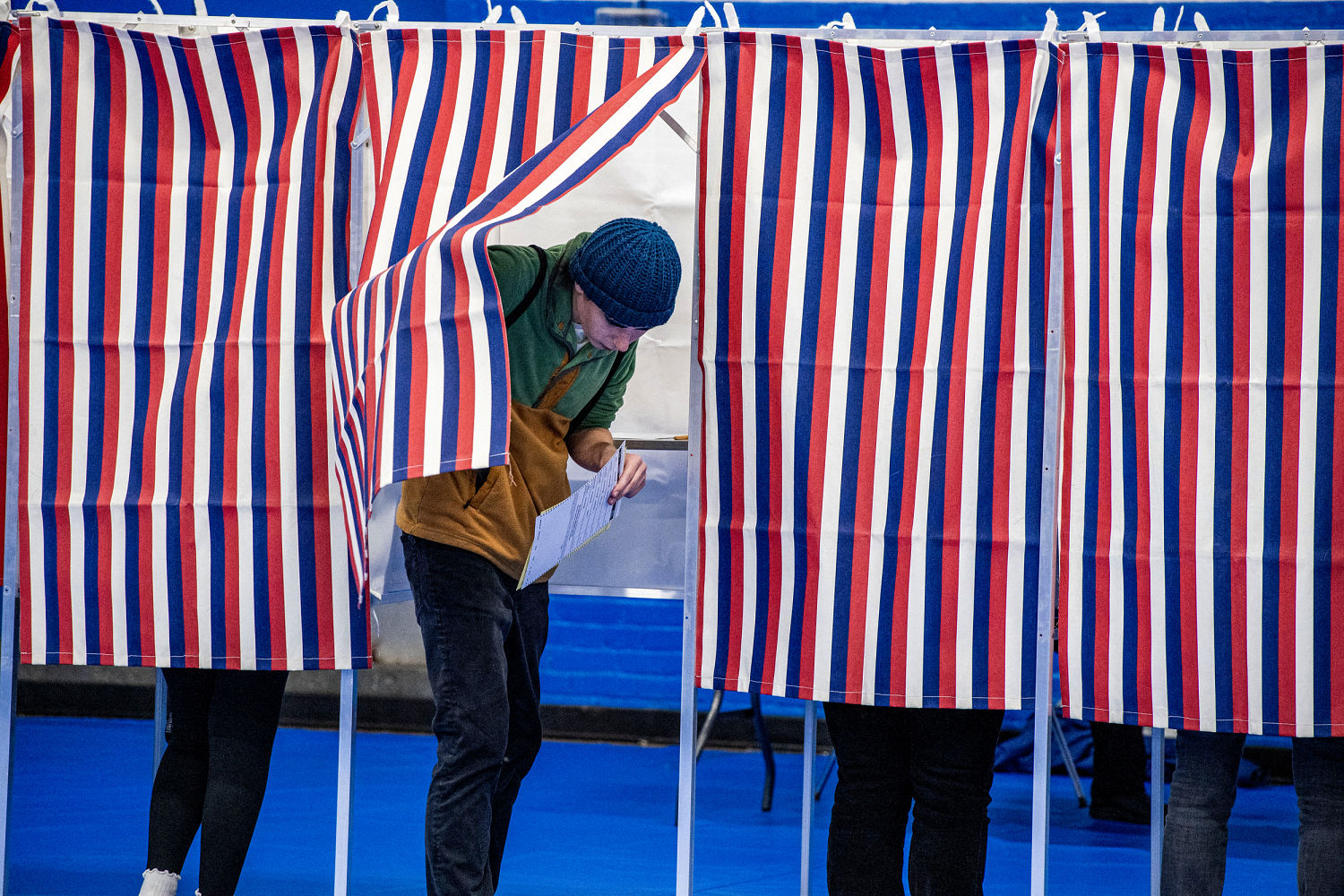 NBC NewsThis piece reads center-left
“In a win for Republicans”
FramingOpens by explicitly labeling the outcome as benefiting Republicans, a partisan characterization other outlets avoid in their opening sentences.
Read the original The HillThis piece reads center
“ruled New Hampshire's top election official can fully stop voters”
Read the original Just the NewsThis piece reads center
“lower federal courts should not alter election rules so close to”
Read the original NYTThis piece reads center
“prevented election officials from considering student IDs”
Read the original- The FederalistThis piece reads center-right
“close student ID 'loophole' in elections”
Word choiceUses the term 'loophole' in quotes, framing the student ID acceptance as an unintended gap to be closed rather than as a voting access provision.
Read the original
Placements are generated by an AI model from each article’s own headline and summary, and every quotation above is checked to be a real substring of that article before it is published. How this is done
Prism is free and carries no advertising. Support it if it was useful.