US and China agree to $30 billion tariff cut and AI dialogue during Xi state visit
Reported by
A dot shows how that piece reads — Prism rates articles, not outlets, and shows the words behind each placement below. No dot means the piece isn’t rated. How the ratings work

What happened
The account the coverage agrees on, with contested figures attributed rather than asserted. This is not one of the five framings below — it is the ground they all stand on.
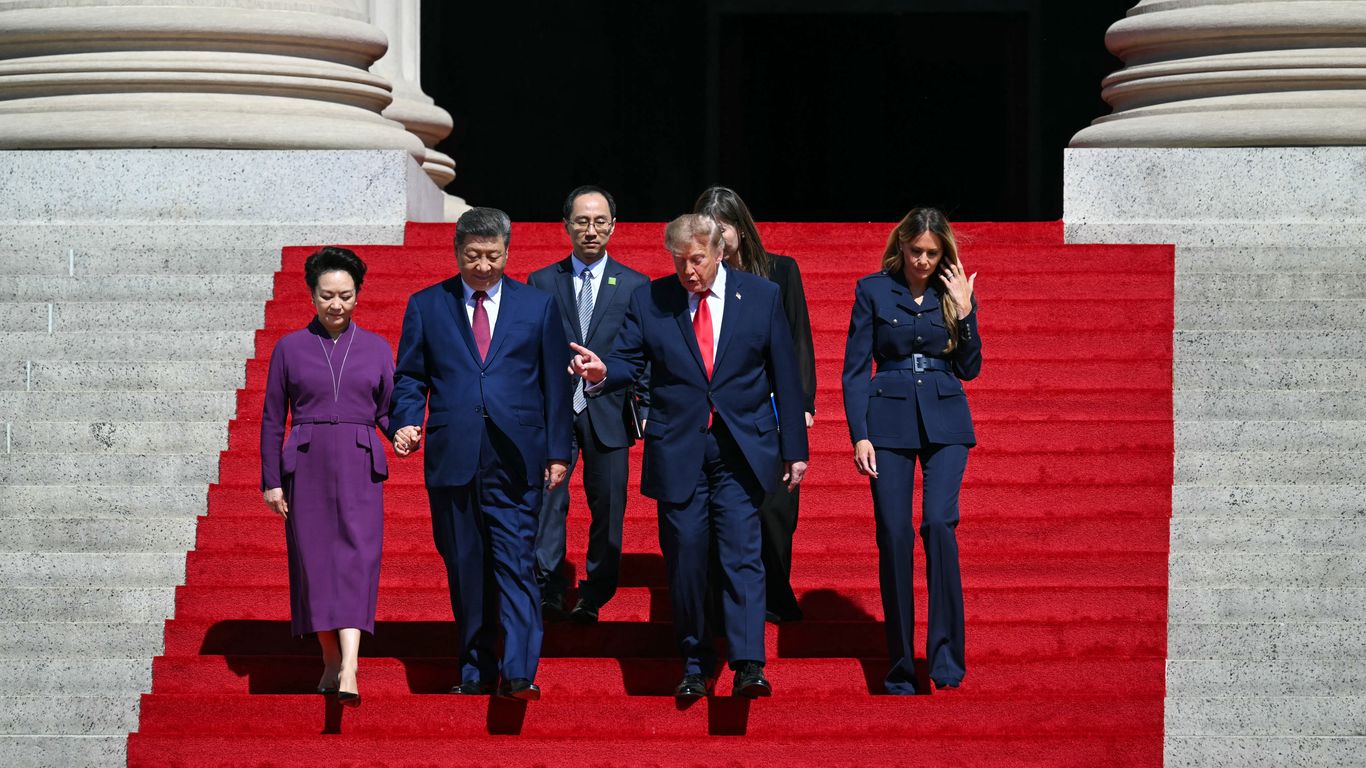
During a three-day state visit to Washington that ended Friday, Chinese President Xi Jinping and President Trump reached an eight-point consensus. The U.S. and China agreed to cut tariffs on $30 billion worth of goods each country imports from the other—specifically described by the White House as "non-sensitive goods." They also agreed to establish a dialogue channel on artificial intelligence to help defuse serious incidents, and to set up a trade council extending outcomes of earlier talks.
How the spectrum reads this story
The same event, summarised as five points on the political spectrum would each tend to frame it. These are generated by an AI model and are a starting point, not the last word.
Left
This tariff deal, while welcome, represents too modest a concession to China given the scale of labor displacement and supply-chain dependence American workers face. A $30 billion cut is a fraction of total trade volumes and does little to address the structural imbalances that let Beijing profit from unfair practices. The AI dialogue is vague—without binding commitments on surveillance, military applications, or intellectual property theft, it risks legitimizing China's position as an equal partner in technology while protecting their state-controlled advantage.
Center-left
The tariff agreement offers modest relief from trade tensions that have hurt American consumers and businesses, and establishing clear communication channels on AI risks is pragmatic. However, the scale of the deal is limited, and it's unclear whether these measures address the underlying competitive concerns about intellectual property, forced technology transfer, or China's state subsidies. The dialogue framework is a useful step, but it needs teeth—specific commitments, not just better communication.
Center
This agreement represents the kind of incremental progress that reduces immediate friction without forcing either side to abandon core positions. A $30 billion tariff cut is meaningful enough to lower prices for American consumers and ease business uncertainty, while an AI dialogue acknowledges mutual risks that benefit from de-escalation. The emphasis on personal diplomacy over grand breakthroughs is honest about what's realistic. The real question is whether these agreements will hold and whether they create momentum for addressing deeper trade imbalances over time.
Center-right
The tariff agreement demonstrates the value of direct negotiation—Trump's approach of engaging Xi personally yielded concrete results that previous administrations couldn't achieve. Cutting tariffs on $30 billion of non-sensitive goods reduces costs for American consumers and businesses without compromising national security by protecting sensitive sectors. The AI dialogue is prudent: competition with China is real, but uncontrolled miscalculation is dangerous. This balances economic realism with the need to maintain firm guardrails on technology that matters.
Right
While tariff relief is welcome for businesses and consumers, this agreement risks letting China off too easily. The $30 billion cut must be carefully vetted to ensure no 'non-sensitive' classification becomes a backdoor for espionage or dumping. More importantly, dialogue on AI cannot mean compromising American technological sovereignty or allowing Beijing a seat at the table in decisions about Western security. Personal diplomacy is fine, but America must never negotiate from weakness or treat an authoritarian competitor as a normal partner.
Hear two viewpoints debate it
Pick two viewpoints and Prism writes a short, six-turn exchange about this story in each one’s own voice — steel-manned, no winner declared. Each pairing is written once and then saved for every reader. The voices are AI syntheses of a tradition, not real people.
New pairing — Prism will write it now.
How each outlet covered it
Where Prism places each piece — not the outlet in general — with the words from that piece that put it there, and the photograph the outlet chose. Picking a photo is a framing decision too.
 Axiosnot rated
Word choiceUses scare quotes around 'super intelligence'—a term not used by other outlets—which emphasizes the formal or elevated nature of the AI agreement in a way that may strike readers as either ambitious or somewhat inflated.
Read the original- CNBCThis piece reads center-left
“showcased personal diplomacy rather than big public breakthroughs”
FramingFrames the summit's achievements as limited by emphasizing personal diplomacy over substantive results, whereas other outlets present the tariff cut and AI dialogue as concrete accomplishments.
Read the original - NewsNationnot ratedRead the original
 The HillThis piece reads center
“agreed to lower tariffs on $30 billion worth of goods”
Read the original- The Express TribuneThis piece reads center
“China, US agree to $30b tariff cut, AI dialogue”
Read the original - The Jerusalem PostThis piece reads center
“China, US agree to $30 billion tariff cut, AI dialogue”
Read the original

Placements are generated by an AI model from each article’s own headline and summary, and every quotation above is checked to be a real substring of that article before it is published. How this is done
Prism is free and carries no advertising. Support it if it was useful.