Trump gives Xi Jinping rare airport welcome as summit visit begins
Reported by
A dot shows how that piece reads — Prism rates articles, not outlets, and shows the words behind each placement below. No dot means the piece isn’t rated. How the ratings work

What happened
The account the coverage agrees on, with contested figures attributed rather than asserted. This is not one of the five framings below — it is the ground they all stand on.
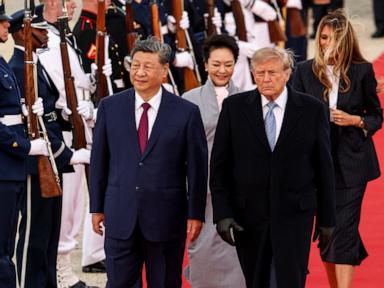
Chinese President Xi Jinping arrived in Washington on Wednesday evening for a state visit. President Trump greeted him on the tarmac at Joint Base Andrews, an unusual gesture for a presidential welcome. The US treasury secretary announced that the US and China had extended their trade truce to January 10. The visit is focused on discussions about trade, artificial intelligence, and Iran.
How the spectrum reads this story
The same event, summarised as five points on the political spectrum would each tend to frame it. These are generated by an AI model and are a starting point, not the last word.
Left
Trump's lavish welcome to Xi masks the fundamental contradictions in US-China relations: while the administration courts Beijing with ceremonial pomp, it maintains hostile policies on trade and technology that reflect deeper structural competition for global dominance. The extended trade truce is a temporary patch that doesn't address the underlying power struggle or the human rights concerns that should shape foreign policy. This summit exemplifies how both superpowers prioritize geopolitical advantage over principles.
Center-left
The state visit and extended trade truce represent a pragmatic effort to stabilize US-China relations at a critical moment, particularly on trade and AI governance. However, significant tensions remain unresolved—Taiwan, technology competition, and strategic competition in the Indo-Pacific are not easily addressed through diplomatic theater. The administration should pursue dialogue while maintaining firm positions on protecting American economic and security interests and pressing China on human rights and fair trade practices.
Center
Trump's personal airport welcome is a calculated diplomatic gesture aimed at creating space for negotiations on shared concerns: trade tensions, AI governance, and regional stability including Iran. The extended trade truce suggests both sides see benefit in avoiding escalation, but the substance matters more than the ceremony. Success depends on whether discussions on these complex issues produce concrete agreements, not on the symbolism of the welcome. Both sides have competing interests that won't vanish with goodwill.
Center-right
The Trump administration is right to engage directly with China's leadership to reduce tensions and pursue American interests in trade and technology. The extended trade truce demonstrates that personal diplomacy and negotiation from strength can work better than confrontational posturing. The focus should remain on securing favorable trade terms, protecting American technological advantage, and ensuring China respects its commitments. A stable relationship with China serves American security and economic interests.
Right
Trump's direct engagement with Xi reflects sound leadership—a president willing to negotiate face-to-face rather than hide behind bureaucracy. Extending the trade truce protects American workers and businesses from unnecessary tariff warfare while the administration pursues better terms. However, vigilance is essential: China's track record on agreements is poor, and any deal must genuinely serve American sovereignty and economic interests. The pomp and ceremony matter less than ensuring the US doesn't get taken advantage of in negotiations.
Hear two viewpoints debate it
Pick two viewpoints and Prism writes a short, six-turn exchange about this story in each one’s own voice — steel-manned, no winner declared. Each pairing is written once and then saved for every reader. The voices are AI syntheses of a tradition, not real people.
New pairing — Prism will write it now.
How each outlet covered it
Where Prism places each piece — not the outlet in general — with the words from that piece that put it there, and the photograph the outlet chose. Picking a photo is a framing decision too.
- Washington Postnot rated
FramingEmphasizes the rarity and diplomatic significance of Trump's tarmac greeting, framing it as noteworthy precisely because it breaks protocol.
Read the original 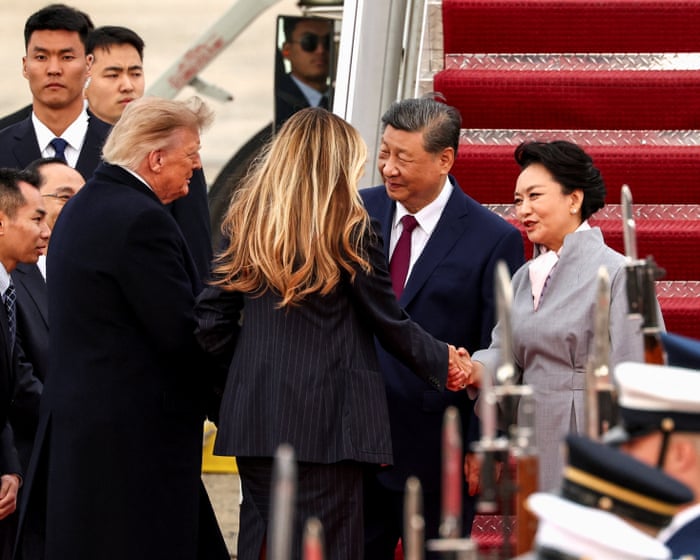 The GuardianThis piece reads center-left
“pausing trade war hostilities”
Word choiceFrames the truce as a pause in 'hostilities,' language that echoes military conflict and emphasizes the adversarial nature of trade relations.
Read the original- BBCThis piece reads center
“US treasury secretary said that the US and China had reached an agreement”
Read the original 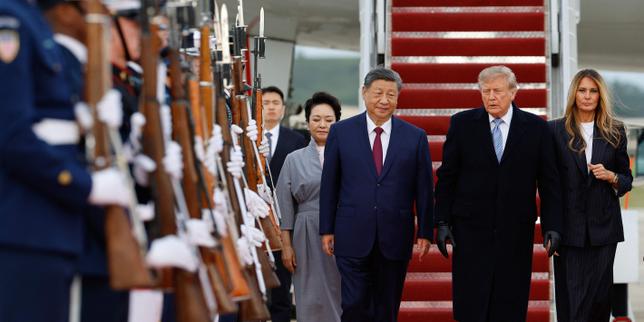
 ABC NewsThis piece reads center
“trade truce between the two countries is extended to Jan. 10”
Read the original- EuronewsThis piece reads center
“grand welcome to his Chinese counterpart Xi Jinping”
Read the original 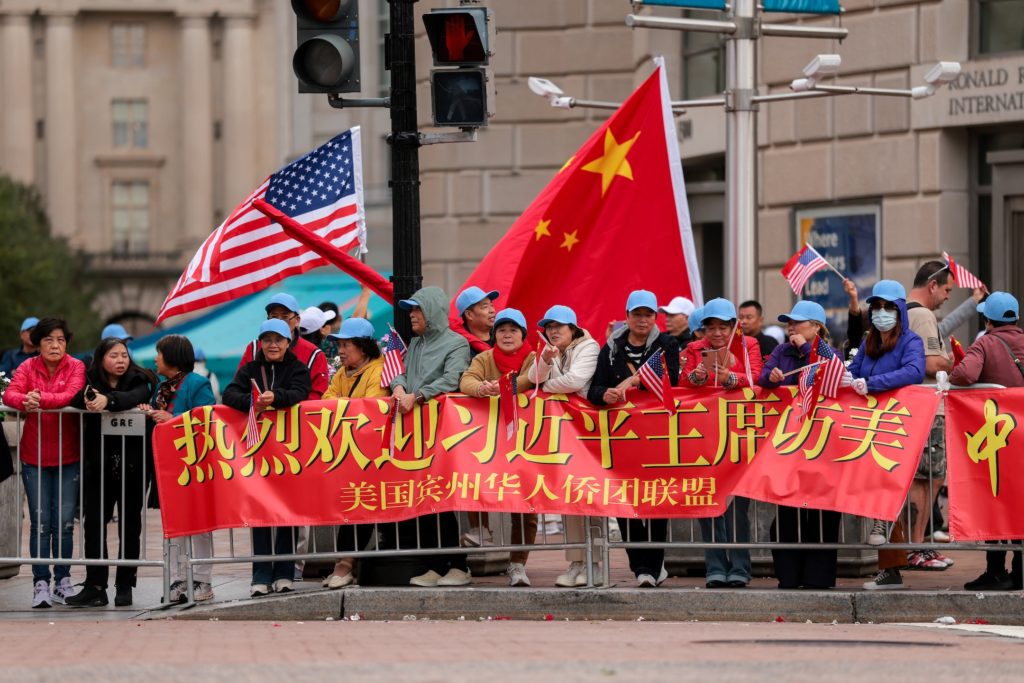 PBS NewsHourThis piece reads center
“state visit amid U.S.-China trade tensions and AI concerns”
What's left outOpens with the visit but leads the snippet by pivoting to an unrelated story about Trump's ban on media outlets from the White House, mixing separate events in the same report.
Read the original France 24This piece reads center
“fragile diplomatic and economic truce”
Word choiceDescribes the truce as 'fragile,' adding an interpretive layer about its durability that other outlets state as plain fact.
Read the original The SunThis piece reads center-right
“welcomes Chinese dictator for high-stakes visit”
Word choiceUses 'dictator' to describe Xi where other outlets use 'president' or 'leader'—a characterization that carries strong judgment about the nature of his rule.
Read the original
Placements are generated by an AI model from each article’s own headline and summary, and every quotation above is checked to be a real substring of that article before it is published. How this is done
Prism is free and carries no advertising. Support it if it was useful.