Germany's Merz visits Kyiv amid Russian strikes on Ukrainian cities and bridges
Reported by
A dot shows how that piece reads — Prism rates articles, not outlets, and shows the words behind each placement below. No dot means the piece isn’t rated. How the ratings work

What happened
The account the coverage agrees on, with contested figures attributed rather than asserted. This is not one of the five framings below — it is the ground they all stand on.
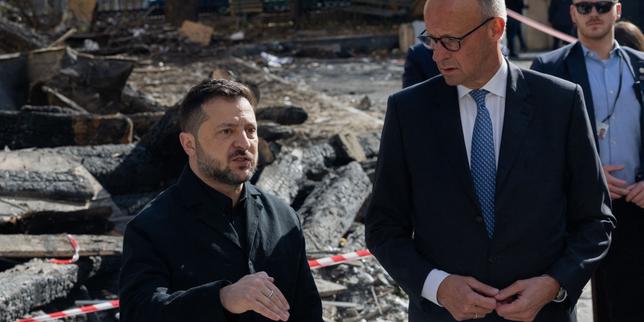
German Chancellor Friedrich Merz arrived in Kyiv on an unplanned visit on October 4, 2026, to demonstrate support for Ukraine. Russian forces struck a major bridge spanning the Dnipro River during or shortly after his arrival—the second consecutive day of such attacks. Merz announced 1 billion euros in military aid and 350 million euros for energy sector repairs, and is expected to finalize a drone production deal. Traffic on the damaged bridge has resumed, though slowly.
How the spectrum reads this story
The same event, summarised as five points on the political spectrum would each tend to frame it. These are generated by an AI model and are a starting point, not the last word.
Left
Merz's visit underscores Germany's deepening military commitment to Ukraine, but the timing exposes the futility of symbolic gestures when faced with Russia's relentless infrastructure destruction. The aid package, while substantial, cannot address the systemic devastation of a war that escalates daily. This moment crystallizes how Western support, even generous, remains reactive rather than pursuing the diplomatic off-ramps that might actually end the bloodshed.
Center-left
Germany is stepping up its backing for Ukraine with concrete financial and military support during a critical phase of the war. Merz's surprise visit and the announced aid—including drone production cooperation—signal strengthened European resolve. Russia's continued attacks on civilian infrastructure, including bridges hit two days running, underscore the need for sustained international support and deterrence while exploring eventual diplomatic pathways.
Center
Merz's visit balances symbolic solidarity with practical measures: substantial aid, energy repairs, and drone cooperation. The timing is awkward—Russian attacks during the visit complicate the message—but such overlaps are inevitable in an active conflict. The announcements address immediate Ukrainian needs without committing Germany to open-ended escalation, a prudent middle ground between abandonment and unlimited involvement.
Center-right
Germany is rightly reinforcing Ukraine's defenses with military and economic aid, demonstrating that European nations can strengthen deterrence without reckless provocation. Merz's visit affirms NATO's eastward commitment and signals resolve. However, the focus should remain on Ukraine's self-defense capabilities and preparing for a negotiated settlement, not on deepening German military entanglement that might widen the conflict.
Right
Germany is being drawn into deepening military involvement in a regional conflict where direct German interests are secondary. While Ukraine deserves support, Germany should prioritize its own security, sovereignty, and economic stability rather than open-ended commitments that depend on American leadership. Merz's aid package and drone deals represent mission creep away from a diplomatic solution that could serve everyone's interests.
Hear two viewpoints debate it
Pick two viewpoints and Prism writes a short, six-turn exchange about this story in each one’s own voice — steel-manned, no winner declared. Each pairing is written once and then saved for every reader. The voices are AI syntheses of a tradition, not real people.
New pairing — Prism will write it now.
How each outlet covered it
Where Prism places each piece — not the outlet in general — with the words from that piece that put it there, and the photograph the outlet chose. Picking a photo is a framing decision too.
 Politico EuropeThis piece reads center-left
“The visit has been overshadowed by heavy Russian attacks on Kyiv”
FramingFrames Russian strikes as eclipsing the visit's diplomatic purpose, and adds context about 'hardest winter' fears and EU membership tensions—broader stakes other outlets omit.
Read the original- France 24not rated
Word choiceUses 'once again' to emphasize pattern and repetition of Russian strikes, whereas other outlets frame the bridge attack more as a discrete event or as part of widening infrastructure targeting.
Read the original - The Moscow TimesThis piece reads center
“Germany's Merz Arrives in Kyiv to the Sound of Sirens and Explosions”
Read the original - BloombergThis piece reads center
“Russian forces struck a major bridge in Kyiv spanning the Dnipro River”
Read the original - Meduzanot rated
FramingSpecifies that these Dnipro bridge strikes represent a new phase of Russian targeting, whereas other outlets describe them as ongoing infrastructure attacks without marking this as a tactical shift.
Read the original - CNBCnot rated
FramingOpens with Merz's concrete deliverables (aid figures and drone cooperation), whereas other outlets lead with the Russian attacks or the visit's symbolic purpose.
Read the original - The Straits Timesnot ratedRead the original
- DWThis piece reads center
“A Kyiv bridge was hit by a Russian drone shortly after Chancellor Merz arrived”
Read the original

Placements are generated by an AI model from each article’s own headline and summary, and every quotation above is checked to be a real substring of that article before it is published. How this is done
Prism is free and carries no advertising. Support it if it was useful.