White House bars CNN from Air Force One pool for Trump's Tennessee trip
Reported by
A dot shows how that piece reads — Prism rates articles, not outlets, and shows the words behind each placement below. No dot means the piece isn’t rated. How the ratings work
What happened
The account the coverage agrees on, with contested figures attributed rather than asserted. This is not one of the five framings below — it is the ground they all stand on.
The White House barred CNN from traveling on Air Force One with President Trump on Saturday to Knoxville, Tennessee for a college football game. CNN had been scheduled to serve as the television press pool representative for the trip. Al Jazeera reported that Real America's Voice News replaced CNN on the aircraft. Multiple outlets characterized this as the latest in an ongoing dispute between the Trump administration and the network.
How the spectrum reads this story
The same event, summarised as five points on the political spectrum would each tend to frame it. These are generated by an AI model and are a starting point, not the last word.
Left
The Trump administration has systematically targeted CNN, now blocking it from basic press access aboard Air Force One—a vehicle paid for by taxpayers. This represents an authoritarian assault on press freedom and democratic accountability. When a president can unilaterally exclude major news organizations from covering his official activities, he controls the narrative and operates without genuine scrutiny. The replacement of CNN with a friendly outlet shows the administration is deliberately constructing a propaganda apparatus rather than tolerating legitimate oversight.
Center-left
Trump's exclusion of CNN from Air Force One access continues a troubling pattern of hostility toward mainstream media and represents a concerning erosion of press freedoms. While presidents have some discretion over logistics, systematically barring a major news organization from covering presidential travel undermines the principle that a free press serves as a check on executive power. The substitution with a partisan outlet suggests the White House is choosing ideological alignment over professional journalism standards.
Center
The White House's decision to exclude CNN from Air Force One raises legitimate questions about press access and First Amendment concerns, yet the situation is more complicated than either side presents. Presidents do have operational control over Air Force One, but the systematic nature of this exclusion—and its replacement with a preferred outlet—blurs the line between logistical management and political punishment. The dispute reflects deeper polarization: both sides claim to value press freedom but define it differently depending on which outlet is affected.
Center-right
While Trump's friction with CNN is well-documented, the White House has discretion over Air Force One logistics and press pool assignments. If CNN's coverage has been consistently hostile or unfair, the administration has legitimate reasons to manage access. However, the optics matter: replacing a major network with a friendlier outlet looks retaliatory rather than practical. A more defensible approach would be clear, neutral criteria for pool access that apply consistently rather than targeting specific outlets.
Right
CNN has relentlessly attacked President Trump with biased, dishonest coverage, and he has every right to limit access when his administration controls the platform. The press is not entitled to taxpayer-funded travel; credentials are privileges that can be managed. If the White House prefers other outlets that cover fairly, that is a reasonable choice. The outrage over this decision ignores years of CNN's hostility and assumes the press has unlimited rights to government access regardless of their conduct.
Hear two viewpoints debate it
Pick two viewpoints and Prism writes a short, six-turn exchange about this story in each one’s own voice — steel-manned, no winner declared. Each pairing is written once and then saved for every reader. The voices are AI syntheses of a tradition, not real people.
New pairing — Prism will write it now.
How each outlet covered it
Where Prism places each piece — not the outlet in general — with the words from that piece that put it there, and the photograph the outlet chose. Picking a photo is a framing decision too.
- NPRThis piece reads center-left
“First Amendment implications”
FramingExplicitly raises constitutional stakes in the headline, flagging legal significance other outlets mention less prominently or not at all.
Read the original 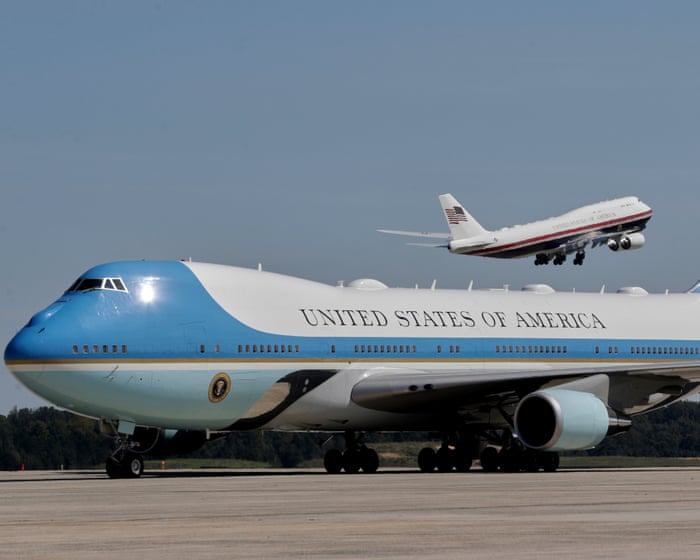 The GuardianThis piece reads center-left
“latest escalation of the administration's battle with the news media”
FramingFrames the decision as part of an escalating conflict, whereas most outlets simply report the exclusion as a discrete action without explicitly characterizing its place in a broader pattern.
Read the original- Al JazeeraThis piece reads center
“Real America's Voice News replaces CNN on Air Force One”
What's left outNames the replacement outlet in the snippet, a detail most others omit, which makes visible the substitution of one network for another—a fact that shapes how the exclusion reads.
Read the original 
 Washington ExaminerThis piece reads center
“CNN has been barred from traveling on Air Force One”
Read the original

- Newsweeknot ratedRead the original
Placements are generated by an AI model from each article’s own headline and summary, and every quotation above is checked to be a real substring of that article before it is published. How this is done
Prism is free and carries no advertising. Support it if it was useful.