Federal judge permanently dismisses Trump's defamation suit against Wall Street Journal over Epstein letter
Reported by
A dot shows how that piece reads — Prism rates articles, not outlets, and shows the words behind each placement below. No dot means the piece isn’t rated. How the ratings work

What happened
The account the coverage agrees on, with contested figures attributed rather than asserted. This is not one of the five framings below — it is the ground they all stand on.
U.S. District Judge Darrin P. Gayles dismissed President Trump's defamation lawsuit against the Wall Street Journal with prejudice on Saturday. The suit concerned the Journal's reporting on a letter Trump allegedly sent to Jeffrey Epstein in 2003. Gayles ruled that Trump failed to prove the defendants made defamatory statements with actual malice as required by law. This is the second dismissal of the lawsuit; with prejudice means Trump cannot refile on the same grounds.
How the spectrum reads this story
The same event, summarised as five points on the political spectrum would each tend to frame it. These are generated by an AI model and are a starting point, not the last word.
Left
The court's decision reaffirms that public figures like Trump face a high bar—actual malice—to win defamation suits, a standard that protects press freedom from powerful people using litigation to silence criticism. This rejection of Trump's attempt to sue a major newspaper over factual reporting demonstrates the judiciary working as intended to preserve the free press against strategic lawsuits.
No article in this story reads this way. This is how the position tends to frame events like it — written by a model, not quoted from anyone.
Center-left
The judge's dismissal upholds important legal precedent protecting journalists from frivolous defamation claims by powerful figures. The actual malice standard ensures that news outlets can report on matters of public interest without paralyzing fear of costly litigation, while still allowing genuine defamation claims to proceed. This outcome protects robust reporting on public officials.
Drawn from 1 article placed here, below.
Center
The court applied well-established defamation law, requiring Trump to meet the actual malice standard that applies to public figures. The dismissal with prejudice—preventing refiling—signals the judge found the claim clearly without merit. Courts must balance protecting reputation against protecting press freedom; this ruling reflects the current legal framework's weight on the latter for reporting on public figures.
Drawn from 3 articles placed here, below.
Center-right
The judge applied existing defamation law as written, though the actual malice standard does make it difficult for public figures to challenge false reporting. The dismissal ends this particular case, but the underlying question of media accuracy and accountability remains. Courts must enforce the law as it stands, even when that limits recourse against unfavorable coverage.
Drawn from 1 article placed here, below.
Right
The dismissal reflects how current defamation law stacks the deck against public figures seeking accountability from powerful media institutions. The actual malice standard, while legally established, makes it nearly impossible for anyone in the public eye to challenge false or misleading reporting. Major outlets operate with substantial immunity to publish negative stories, limiting meaningful consequences for inaccuracy.
No article in this story reads this way. This is how the position tends to frame events like it — written by a model, not quoted from anyone.
Hear two viewpoints debate it
Pick two viewpoints and Prism writes a short, six-turn exchange about this story in each one’s own voice — steel-manned, no winner declared. Each pairing is written once and then saved for every reader. The voices are AI syntheses of a tradition, not real people.
New pairing — Prism will write it now.
How each outlet covered it
Where Prism places each piece — not the outlet in general — with the words from that piece that put it there, and the photograph the outlet chose. Picking a photo is a framing decision too.
 The HillThis piece reads center-left
“dismissed for the second time”
Word choiceLeads with 'second time' where other outlets either omit this or bury it, emphasizing Trump's repeated legal failure on the same claim.
Read the original Straight Arrow NewsThis piece reads center
“failed to plausibly prove the newspaper knowingly published false”
Word choiceStates the legal standard (actual malice) in plain language where other outlets leave it implicit, making the judge's reasoning more explicit to readers unfamiliar with defamation law.
Read the original
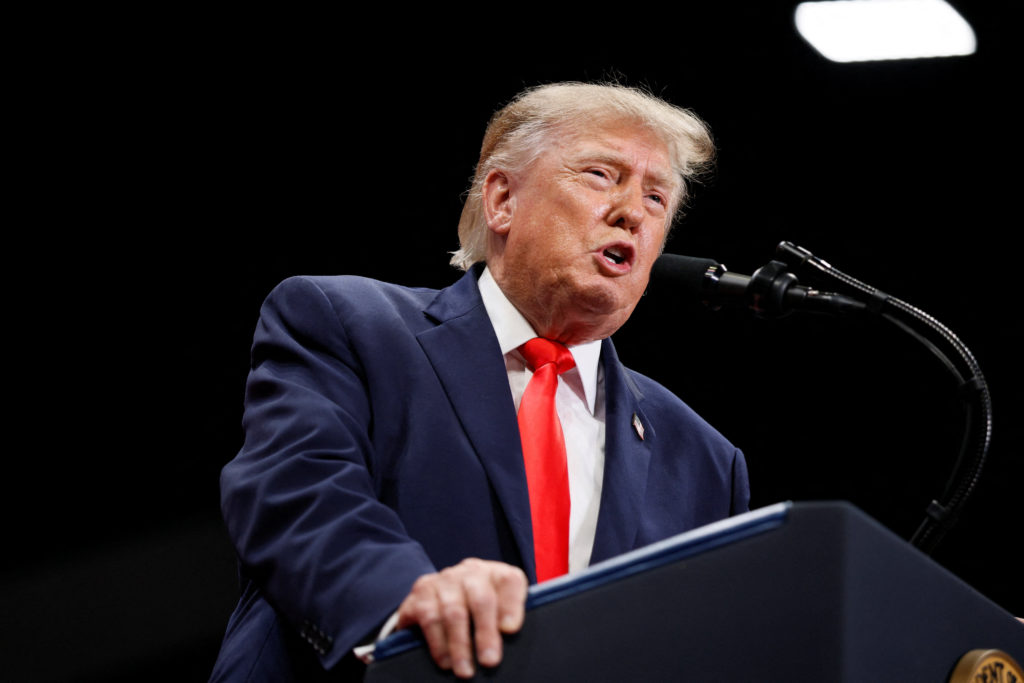 PBS NewsHourThis piece reads center
“did not prove the defendants made defamatory statements with actual malice”
FramingCombines the legal consequence (with prejudice) and the reasoning (actual malice not proven) in one sentence, giving readers both the finality and the grounds in compact form.
Read the original- Washington ExaminerThis piece reads center-right
“Obama-appointed U.S. District Judge”
What's left outIdentifies the judge's appointing president before stating his ruling, a detail other outlets omit—the choice to lead with this backgrounder emphasizes the judge's political origin rather than the legal reasoning.
Read the original
Placements are generated by an AI model from each article’s own headline and summary, and every quotation above is checked to be a real substring of that article before it is published. How this is done
Prism is free and carries no advertising. Support it if it was useful.