Canada proposes closer alliance with EU as first associate member state
Reported by
A dot shows how that piece reads — Prism rates articles, not outlets, and shows the words behind each placement below. No dot means the piece isn’t rated. How the ratings work
PBS NewsHour
What happened
The account the coverage agrees on, with contested figures attributed rather than asserted. This is not one of the five framings below — it is the ground they all stand on.
European Commission President Ursula von der Leyen proposed that Canada become the first "associate member" of the European Union. Canadian Prime Minister Mark Carney addressed the European Parliament in France, receiving a standing ovation, and called for deeper partnership between Canada and Europe. The proposal emerged as Canada navigates an ongoing trade war with the United States. EU officials have expressed support but there is no certainty the idea will advance or serve as a model for other countries.
How the spectrum reads this story
The same event, summarised as five points on the political spectrum would each tend to frame it. These are generated by an AI model and are a starting point, not the last word.
Left
Canada's turn toward Europe represents a necessary rejection of Trump's economic nationalism and a pivot toward multilateral cooperation and shared sovereignty among democracies. This alliance could strengthen labor standards, environmental protections, and fair trade practices across the Atlantic, offering an alternative to the extractive, bilateral deals favored by the right. However, the EU associate membership proposal must be scrutinized to ensure it doesn't become another corporate-friendly trade arrangement that prioritizes capital flows over workers and communities.
Center-left
Carney's outreach to Europe is a pragmatic response to deteriorating US-Canada relations and shows smart diplomacy in building diverse partnerships. Associate membership could open new economic opportunities, facilitate people-to-people exchange, and strengthen democratic alliances at a time of geopolitical tension. The proposal should be evaluated on whether it delivers concrete benefits in trade, investment, and mobility without compromising Canada's existing North American commitments or creating unnecessary friction with the US.
Center
Canada is exploring a significant realignment of its international relationships, balancing its traditional North American ties against emerging opportunities in Europe. While closer EU ties could diversify Canada's economic and strategic interests, the practical mechanics of associate membership remain unclear and untested. Both the costs and benefits need serious analysis before commitment; enthusiasm from European leaders doesn't guarantee either rapid implementation or that the model will work as intended for either party.
Center-right
Carney is pursuing a legitimate diversification of Canada's economic partnerships in response to US trade tensions, which is reasonable statecraft. However, policymakers should be cautious about overcommitting to European structures that could complicate existing trade arrangements or dilute sovereignty in unexpected ways. The proposal is vague on details—what associate membership actually means, what obligations it creates, and whether it conflicts with USMCA. Canada should negotiate carefully and keep its options open rather than rushing into an untested arrangement.
Right
Carney is abandoning Canada's foundational North American partnership and subordinating Canadian sovereignty to European institutions in response to legitimate US trade policies. This pivot toward Europe weakens Canada's negotiating position with the US and risks entangling the country in European political and military commitments that don't serve Canadian interests. Canada should focus on resolving disputes with its closest neighbor through direct negotiation rather than seeking distant alliances that signal weakness and dependency on multilateral bureaucracies.
Hear two viewpoints debate it
Pick two viewpoints and Prism writes a short, six-turn exchange about this story in each one’s own voice — steel-manned, no winner declared. Each pairing is written once and then saved for every reader. The voices are AI syntheses of a tradition, not real people.
New pairing — Prism will write it now.
How each outlet covered it
Where Prism places each piece — not the outlet in general — with the words from that piece that put it there, and the photograph the outlet chose. Picking a photo is a framing decision too.
 CBC Newsnot rated
FramingFrames the initiative as Carney's strategic vision against great-power encroachment, emphasizing defensive sovereignty rather than economic opportunity or trade diversification.
Read the original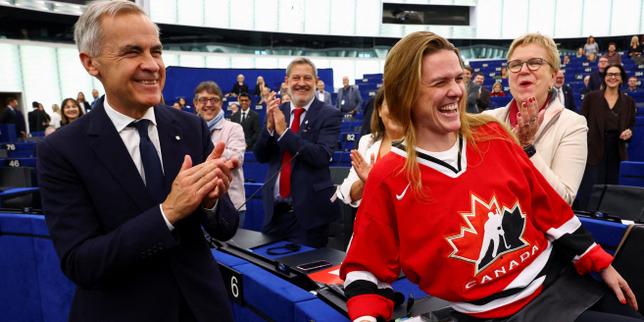 Le MondeThis piece reads center-left
“Ignoring threats from US President Donald Trump”
Word choiceExplicitly characterizes Carney's move as defying Trump's warnings, whereas other outlets present the EU proposal and US trade tensions as separate context.
Read the original PoliticoThis piece reads center
“Jay Jacobs gets his first-ever challenger for state Dem chair”
Read the original BBCnot ratedRead the original
 Global NewsThis piece reads center
“How EU leaders are reacting to Canada associate membership proposal”
Word choiceMentions Canadian cultural exports alongside critical minerals and defence in EU leaders' reactions, injecting a lighter tone absent from other coverage.
Read the original PBS NewsHourThis piece reads center
“Experts say it's unclear exactly how such a re”
What's left outSnippet cuts off mid-sentence, but the framing introduces expert skepticism about implementation details earlier than other outlets do.
Read the original- EuronewsThis piece reads center
“historic deepening of ties between Canada and the European Union”
Read the original
Placements are generated by an AI model from each article’s own headline and summary, and every quotation above is checked to be a real substring of that article before it is published. How this is done
Prism is free and carries no advertising. Support it if it was useful.