Mark Carney pitches Canada to global investors as trade war with US intensifies
Reported by
A dot shows how that piece reads — Prism rates articles, not outlets, and shows the words behind each placement below. No dot means the piece isn’t rated. How the ratings work

What happened
The account the coverage agrees on, with contested figures attributed rather than asserted. This is not one of the five framings below — it is the ground they all stand on.
Canadian Prime Minister Mark Carney is hosting a Canada Investment Summit to court global investors and reduce economic dependence on the United States as trade tensions escalate. Trump has signed executive orders to ban Canadian imports including alcohol, motorcycles, and dairy products. Carney plans to discuss a "unique alliance" with the European Union this week when he addresses the European Parliament, explicitly ruling out EU membership.
How the spectrum reads this story
The same event, summarised as five points on the political spectrum would each tend to frame it. These are generated by an AI model and are a starting point, not the last word.
Left
Carney is attempting damage control after decades of integrating Canada's economy with the US. The real solution requires deep structural changes: diversifying away from resource extraction and US-dependent manufacturing, investing in domestic capacity, and building genuine partnerships with Europe and the Global South based on equity rather than just hedging bets. A trade war shows how vulnerable dependency makes us—this is a moment to imagine a different economic model, not just find new investors to prop up the old one.
Center-left
Carney is taking the right steps by seeking investment diversification and stronger EU ties, but the government needs to move faster and more decisively. The US trade war is a shock that demands not just investor relations but real industrial policy: targeted support for sectors that can compete globally, workforce retraining, and infrastructure investment. The EU alliance is promising, but Canada must also strengthen domestic capacity so it isn't simply swapping dependence on one partner for another.
Center
Carney's response balances pragmatism with ambition: you can't ignore the US market, but you also can't be hostage to it. Hosting investors and exploring EU ties are sensible moves that acknowledge economic reality without overcommitting. The challenge is execution—whether these initiatives actually reduce vulnerability or just buy time. EU membership would be overreach; a practical alliance makes sense. The real test is whether this translates into concrete deals and measurable diversification, not just rhetoric.
Center-right
Carney is right to pursue investment and new trade partners, but the government should be careful not to overregulate or discourage business in the process. Free trade and open investment are Canada's strengths; the focus should be on removing barriers and making Canada attractive to capital, not picking industrial winners. The EU discussion is useful, but Canada shouldn't tie itself to European red tape. The priority is a competitive business environment and, ultimately, working out differences with the US rather than treating it as permanent adversary.
Right
Carney is correct to recognize that excessive dependence on the US is a strategic vulnerability, but his solution—courting global investors and EU alignment—risks entangling Canada in foreign commitments that undermine sovereignty. Canada should prioritize its own citizens and workers, not multinational capital flows. The real answer is building resilient domestic production, protecting key sectors, and negotiating from strength with the US as a neighbor, not as a supplicant. EU ties should never come at the cost of Canadian independence or values.
Hear two viewpoints debate it
Pick two viewpoints and Prism writes a short, six-turn exchange about this story in each one’s own voice — steel-manned, no winner declared. Each pairing is written once and then saved for every reader. The voices are AI syntheses of a tradition, not real people.
New pairing — Prism will write it now.
How each outlet covered it
Where Prism places each piece — not the outlet in general — with the words from that piece that put it there, and the photograph the outlet chose. Picking a photo is a framing decision too.
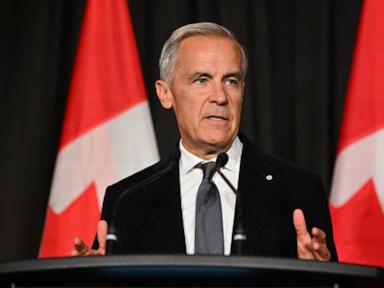 ABC NewsThis piece reads center-left
“Trump tries to pull investment south”
Word choiceFrames Trump's actions as actively recruiting investment away from Canada, whereas other outlets describe the tariffs as trade war measures. The phrase suggests intentional extraction rather than punitive policy.
Read the original CBC Newsnot ratedRead the original
 BBCnot ratedRead the original
 Global Newsnot rated
Word choiceDescribes Trump's executive orders as "lashed out," an emotionally loaded phrase suggesting anger or retaliation, while other outlets describe the orders more neutrally.
Read the original The Globe and MailThis piece reads center
“Canada starting to draw attention from global investors”
Read the original
Placements are generated by an AI model from each article’s own headline and summary, and every quotation above is checked to be a real substring of that article before it is published. How this is done
Prism is free and carries no advertising. Support it if it was useful.