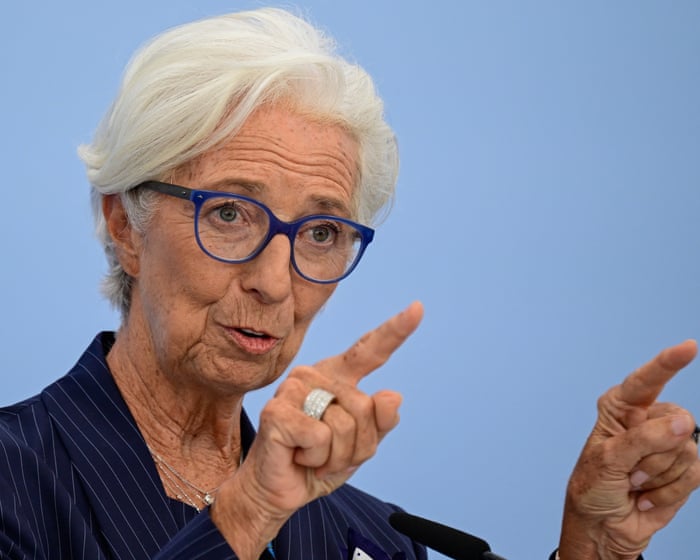
ECB raises interest rates to 2.5% as Middle East war fuels inflation
Reported by
A dot shows how that piece reads — Prism rates articles, not outlets, and shows the words behind each placement below. No dot means the piece isn’t rated. How the ratings work
What happened
The account the coverage agrees on, with contested figures attributed rather than asserted. This is not one of the five framings below — it is the ground they all stand on.
The European Central Bank raised interest rates to 2.5%, citing rising inflation risks from renewed Middle East fighting. Oil prices climbed above $100 a barrel. Saudi Arabia's crude output fell to 6.238 million barrels per day in August, the lowest in 36 years, following Houthi threats to shipping and a July announcement of a 'maritime embargo' against the kingdom's exports.
How the spectrum reads this story
The same event, summarised as five points on the political spectrum would each tend to frame it. These are generated by an AI model and are a starting point, not the last word.
Left
Central banks are raising rates to fight inflation caused by geopolitical instability and resource scarcity, but this approach will slow growth and hurt workers and debtors most. The real problem is oil dependence and war — we need rapid investment in renewables and diplomatic solutions, not austerity that concentrates pain on ordinary people.
Center-left
The ECB's rate increase is a necessary tool to control inflation pressures from Middle East tensions and oil supply constraints. However, higher rates will slow growth and increase borrowing costs for households and businesses. The focus should be on both taming inflation and protecting vulnerable groups, while supporting a transition away from oil dependency.
Center
The ECB faces a difficult balancing act: inflation is rising due to external shocks beyond its control, so rate increases are needed to maintain credibility and prevent expectations from becoming unanchored. But these increases carry real costs for borrowers and growth. The ideal response combines careful monetary policy with efforts to stabilize oil markets and resolve the underlying regional conflict.
Center-right
Rate increases are the appropriate response to inflation driven by supply disruptions in a critical commodity. Higher borrowing costs create necessary discipline and prevent demand from outpacing constrained supply. The ECB is right to act decisively. The real solutions are supporting energy security, removing regulatory barriers to production, and resolving conflict that destabilizes markets.
Right
Inflation is forcing the ECB to raise rates, which will harm households and businesses already squeezed by economic policies. The underlying problem is energy insecurity caused by dependence on unstable regions and failed foreign policy. Europe needs energy independence through its own resources and production, not rate hikes that punish citizens for problems created by others' decisions.
Hear two viewpoints debate it
Pick two viewpoints and Prism writes a short, six-turn exchange about this story in each one’s own voice — steel-manned, no winner declared. Each pairing is written once and then saved for every reader. The voices are AI syntheses of a tradition, not real people.
New pairing — Prism will write it now.
How each outlet covered it
Where Prism places each piece — not the outlet in general — with the words from that piece that put it there, and the photograph the outlet chose. Picking a photo is a framing decision too.
- The GuardianThis piece reads center
“ECB raises interest rates to 2.5% and warns”
Word choiceAttributes the inflation risk specifically to 'Iran war,' naming one party explicitly where Al-Monitor and others reference the broader regional conflict more neutrally.
Read the original  The Irish TimesThis piece reads center
Headline changedwas “ECB interest rate hike: What does it mean for you and your pocket?”
“What does it mean for you and your pocket”
Read the original Financial TimesThis piece reads center
“Saudi Arabia cuts oil output to lowest this year”
FramingPlaces 'maritime embargo' in scare quotes, suggesting skepticism about whether the announcement constitutes a formal embargo, while other outlets report the production cuts without quotation marks around the cause.
Read the original- Al-MonitorThis piece reads center
“Saudi Arabia's oil production slumps to lowest in 36 years”
Word choiceThe phrase 'slumps to lowest in 36 years' emphasizes the severity and historical scale of the decline more sharply than the FT's framing of it as a response to specific threats.
Read the original - Hungarian ConservativeThis piece reads center-right
“World Economy Braces for Impact as Brent Crude Oil”
Read the original
Placements are generated by an AI model from each article’s own headline and summary, and every quotation above is checked to be a real substring of that article before it is published. How this is done
Prism is free and carries no advertising. Support it if it was useful.