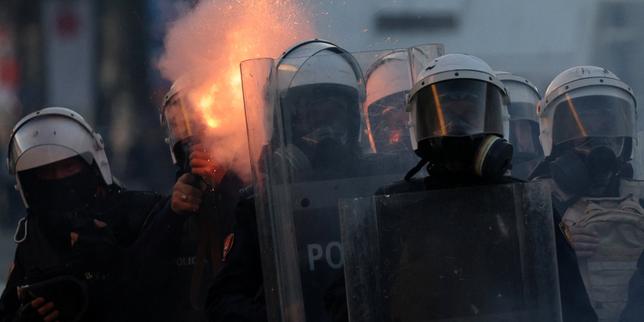
Albania's capital sees violent anti-government protests with tear gas and petrol bombs as protests escalate over PM Rama
Reported by
A dot shows how that piece reads — Prism rates articles, not outlets, and shows the words behind each placement below. No dot means the piece isn’t rated. How the ratings work
What happened
The account the coverage agrees on, with contested figures attributed rather than asserted. This is not one of the five framings below — it is the ground they all stand on.
Thousands of demonstrators in Tirana, Albania's capital, protested on Wednesday demanding Prime Minister Edi Rama's resignation and better university conditions. Over several hours, protesters attacked government offices, smashed windows, and set fire to multiple buildings. Police responded with water cannons and tear gas. Police have faced criticism for alleged use of excessive force against protesters and journalists. The protests turned violent for a second consecutive night, leaving several government buildings damaged.
How the spectrum reads this story
The same event, summarised as five points on the political spectrum would each tend to frame it. These are generated by an AI model and are a starting point, not the last word.
Left
Students and working people took to the streets against a government that has failed to provide adequate education and opportunity, demanding Edi Rama step down. The state's response—water cannons, tear gas, and reports of excessive force against demonstrators and journalists—shows how deeply entrenched power resists accountability. This uprising reflects systemic neglect of public services and the concentration of power that demands structural change, not cosmetic reforms.
No article in this story reads this way. This is how the position tends to frame events like it — written by a model, not quoted from anyone.
Center-left
Anti-government protests in Tirana reflect legitimate grievances about university conditions and governance under Prime Minister Rama. While the initial demands were democratic, the escalation into arson and property destruction crossed a line. Police tactics including tear gas warrant scrutiny, and allegations of excessive force against journalists deserve investigation, but order must be restored through dialogue and institutional accountability, not further confrontation.
Drawn from 2 articles placed here, below.
Center
Albania faces a crisis of public trust: students have real complaints about university conditions, and the government has not adequately addressed them, yet neither side has handled the situation well. Protesters' resort to arson and vandalism undermines their legitimate demands, while police deployment of tear gas and allegations of excessive force suggest responses that may worsen rather than resolve the crisis. Both dialogue and restraint are needed—institutional channels exist to address educational reform without escalation on either side.
Drawn from 1 article placed here, below.
Center-right
Prime Minister Rama's government faces serious pressure from students demanding education improvements and political change. While public protest is legitimate, the violence—arson, property destruction, petrol bombs—cannot be justified and destabilizes the capital. Police have a duty to maintain order, though any excessive force allegations should be reviewed. The government must address underlying grievances through policy while enforcing the rule of law and protecting public safety and infrastructure.
No article in this story reads this way. This is how the position tends to frame events like it — written by a model, not quoted from anyone.
Right
Violent mobs torched buildings and attacked government offices in Tirana, requiring police to restore order with tear gas and water cannons. These are not peaceful demonstrations but organized riots that threaten property, public safety, and the functioning of government. Law enforcement has the right and duty to protect citizens and institutions from destruction. Political demands cannot excuse arson and violence; order must be established before any negotiation can occur.
No article in this story reads this way. This is how the position tends to frame events like it — written by a model, not quoted from anyone.
Hear two viewpoints debate it
Pick two viewpoints and Prism writes a short, six-turn exchange about this story in each one’s own voice — steel-manned, no winner declared. Each pairing is written once and then saved for every reader. The voices are AI syntheses of a tradition, not real people.
New pairing — Prism will write it now.
How each outlet covered it
Where Prism places each piece — not the outlet in general — with the words from that piece that put it there, and the photograph the outlet chose. Picking a photo is a framing decision too.
- Politico EuropeThis piece reads center-left
“Police have been criticized for alleged use of excessive force”
What's left outEmphasizes police conduct rather than protester actions, while other outlets lead with the violence protesters committed.
Read the original  Balkan InsightThis piece reads center-left
“violent clashes between demonstrators and police”
Word choiceUses 'tussle' to describe clashes, which softens the characterization compared to other outlets' descriptions of violent escalation.
Read the original- Le MondeThis piece reads center
“police deployed water cannons and tear gas as demonstrators attacked”
Read the original  France 24not ratedRead the original
Placements are generated by an AI model from each article’s own headline and summary, and every quotation above is checked to be a real substring of that article before it is published. How this is done
Prism is free and carries no advertising. Support it if it was useful.