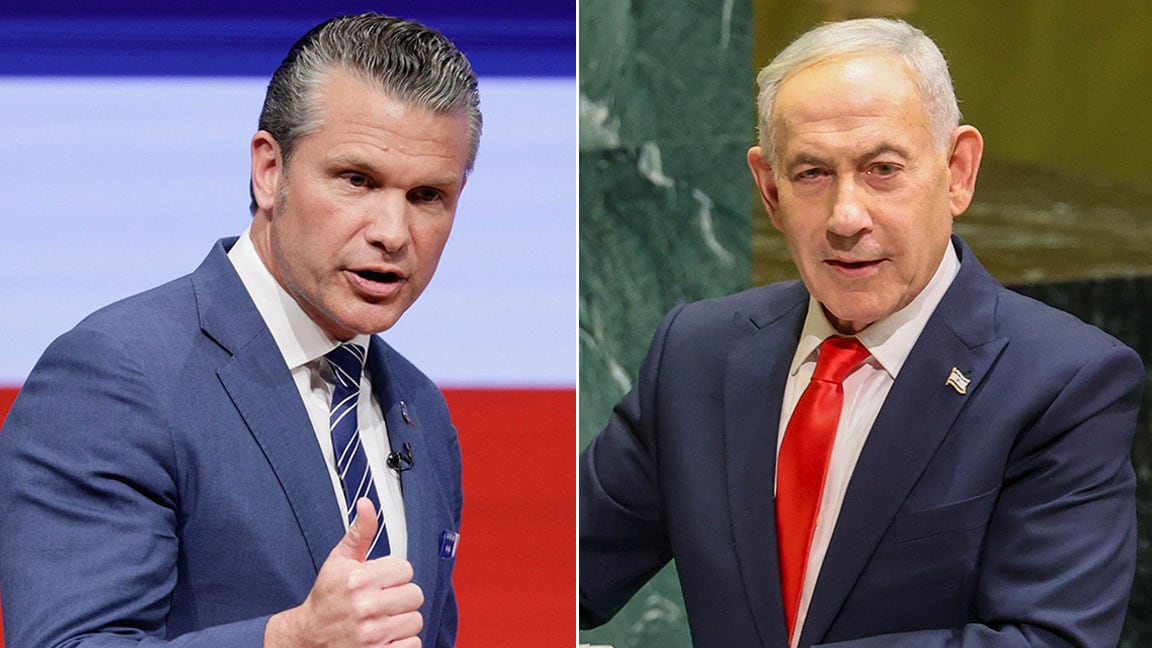
US Defense Secretary Pete Hegseth confirms secret Israel visit to meet Netanyahu
Reported by
A dot shows how that piece reads — Prism rates articles, not outlets, and shows the words behind each placement below. No dot means the piece isn’t rated. How the ratings work

What happened
The account the coverage agrees on, with contested figures attributed rather than asserted. This is not one of the five framings below — it is the ground they all stand on.
US Defense Secretary Pete Hegseth made an unannounced visit to Israel on Monday and met with Prime Minister Benjamin Netanyahu. Hegseth confirmed the visit and meeting but declined to discuss what was covered in their talks. The visit occurs as Netanyahu faces elections and amid reports of US-Iran tensions.
Developing story · 2 chapters
- US Defense Secretary Pete Hegseth makes unannounced visit to Israel to meet Netanyahu ahead of elections
- US Defense Secretary Pete Hegseth confirms secret Israel visit to meet Netanyahuyou are here
How each side framed the previous chapter
Compare these with the five framings below to see what moved as the story developed — and what each side kept saying regardless.
Left
The unannounced visit by the U.S. defense secretary to Israel days before its elections raises concerns about American interference in Israeli politics and signals deeper U.S. commitment to potential military escalation against Iran. The timing and secrecy suggest coordination on expanding conflict in the region rather than pursuing diplomatic solutions, continuing a pattern of military-first approaches that destabilize the Middle East and subordinate Palestinian concerns to U.S.-Israeli strategic interests.
Center-left
Hegseth's secret visit to Netanyahu reflects the administration's close alignment with Israel's government and suggests serious planning for military action against Iran. While the U.S.-Israel relationship is important, the unannounced nature of the meeting and its proximity to Israeli elections raise questions about whether this timing was appropriate and whether the administration is fully considering the regional consequences of resuming major combat operations.
Center
The unannounced visit demonstrates the depth of U.S.-Israeli coordination on security matters, particularly regarding Iran. The timing before Israeli elections is noteworthy but may be coincidental rather than deliberate interference. Officials should balance the legitimate security concerns driving these discussions with transparency—both about the substance of U.S. military planning and about the diplomatic alternatives that should be exhausted before major operations.
Center-right
The Defense Secretary's visit underscores the strong U.S.-Israel partnership and signals resolve on the Iranian threat. The unannounced nature reflects operational security appropriate for sensitive military discussions. The meeting shows the administration is actively engaged in regional security strategy and willing to take decisive action to counter Iranian aggression, working closely with a trusted regional ally.
Right
Hegseth's direct engagement with Netanyahu demonstrates the administration's commitment to supporting Israel against its enemies and addressing the Iranian threat decisively. The unannounced visit reflects proper operational security for sensitive military consultations. This is the kind of clear, strong partnership the U.S. should maintain—direct coordination with allies on real threats rather than endless diplomatic processes that allow hostile regimes to develop weapons.
How the spectrum reads this story
The same event, summarised as five points on the political spectrum would each tend to frame it. These are generated by an AI model and are a starting point, not the last word.
Left
The US Defense Secretary's secret trip to Netanyahu signals dangerous escalation toward Iran conflict. That it happens unannounced and undisclosed—with details kept from public scrutiny—shows how military and political elites coordinate military action outside democratic oversight. Trump administration officials are clearly coordinating with Israel on potential Iran strikes while hiding the substance from the American people, exactly the kind of foreign entanglement and hidden war-making the public should reject.
Drawn from 1 article placed here, below.
Center-left
Hegseth's unannounced visit to Israel raises concerns about transparency and democratic accountability. A Defense Secretary meeting with a foreign leader to discuss potential military action—especially regarding Iran—should not occur in secret. While US-Israel coordination is standard, the secrecy around what was discussed and the proximity to Netanyahu's election suggest the administration may be using military positioning for political purposes, both in Israel and at home.
Drawn from 1 article placed here, below.
Center
The US and Israel maintain close defense ties and regular high-level contact; a Defense Secretary visiting is routine. However, the unannounced nature and refusal to discuss the meeting's content suggest either genuine operational security concerns or an attempt to avoid public scrutiny of sensitive military discussions. The timing near Netanyahu's elections and amid Iran tensions adds legitimate questions about whether this serves strategy or politics—though distinguishing the two is difficult in practice.
Drawn from 3 articles placed here, below.
Center-right
The Defense Secretary appropriately visits a key ally to coordinate on shared security threats, particularly Iran's regional destabilization. Classified military discussions require secrecy; not every diplomatic meeting can be broadcast publicly. The visit reflects proper executive branch management of defense and foreign policy. If renewed Iran strikes are being discussed, that is exactly the kind of threat assessment and allied planning that falls within the president's constitutional authority.
Drawn from 1 article placed here, below.
Right
The US Defense Secretary correctly meets with Israel to discuss countering Iranian aggression and regional threats. Secret military planning is necessary and appropriate—operational details cannot be disclosed to adversaries. This visit demonstrates the Trump administration's commitment to supporting Israel and taking a firm stance against Iran's expansionism. The refusal to discuss specifics is the responsible security posture; leaking military strategy serves no one's interests but America's enemies.
No article in this story reads this way. This is how the position tends to frame events like it — written by a model, not quoted from anyone.
Hear two viewpoints debate it
Pick two viewpoints and Prism writes a short, six-turn exchange about this story in each one’s own voice — steel-manned, no winner declared. Each pairing is written once and then saved for every reader. The voices are AI syntheses of a tradition, not real people.
New pairing — Prism will write it now.
How each outlet covered it
Where Prism places each piece — not the outlet in general — with the words from that piece that put it there, and the photograph the outlet chose. Picking a photo is a framing decision too.
- The American ConservativeThis piece reads left
“Iran War Day 235”
FramingFrames the visit within an ongoing 'Iran War' counted in daily increments, establishing a premise other outlets do not adopt—they report tensions or discussions, not an active numbered conflict.
Read the original - CBS NewsThis piece reads center-left
“ahead of elections, possible Iran war restart”
Read the original - Israel National NewsThis piece reads center
“confirms an unannounced visit to Israel and meeting with Netanyahu”
Word choiceUses the title 'Secretary of War' rather than 'Defense Secretary' or 'Secretary of Defense,' which is the actual cabinet position—this uncommon phrasing emphasizes military rather than defensive function.
Read the original 

Placements are generated by an AI model from each article’s own headline and summary, and every quotation above is checked to be a real substring of that article before it is published. How this is done
Prism is free and carries no advertising. Support it if it was useful.