Israeli election authorities say inquiry into irregularities will not undermine election results
Reported by
A dot shows how that piece reads — Prism rates articles, not outlets, and shows the words behind each placement below. No dot means the piece isn’t rated. How the ratings work
What happened
The account the coverage agrees on, with contested figures attributed rather than asserted. This is not one of the five framings below — it is the ground they all stand on.
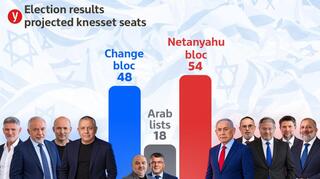
Israeli elections with 65% of polling stations reporting show Likud leading with 27 seats. Netanyahu's bloc holds 54 seats, Eisenkot's Yashar! bloc has 48 seats, and Arab parties have risen to 18 seats. The elections chief said an ongoing Shin Bet investigation into alleged foreign funding of the Arab Israeli party Raam—specifically whether it received money from Qatar—will not undermine the election result, noting that "suspicions remain suspicions." Some opposition figures, including Yair Golan, have called for a government backed by Arab parties.
How the spectrum reads this story
The same event, summarised as five points on the political spectrum would each tend to frame it. These are generated by an AI model and are a starting point, not the last word.
Left
The election results show a potential opening for genuine political change: Netanyahu's bloc lost its previous dominance, Arab parties more than doubled their representation to 18 seats, and a viable alternative coalition is mathematically possible. This represents Palestinians and Arab Israelis gaining real electoral power to shape government policy. The investigation into Raam's funding appears designed to delegitimize Arab participation in government—a tactic to prevent the coalition-building that could actually end Netanyahu's control and allow a government more responsive to Palestinian concerns and equality for Arab citizens.
No article in this story reads this way. This is how the position tends to frame events like it — written by a model, not quoted from anyone.
Center-left
These results reflect significant political shifts: Netanyahu's bloc weakened substantially, and Arab parties have emerged as potential kingmakers with 18 seats. The investigation into Raam's funding must proceed transparently, but the elections chief is right that suspicions should not delegitimize results without evidence. Arab parties can play a legitimate role in forming a coalition government, and their increased representation gives them meaningful influence over policy. A government including Arab participation could help address inequality and open space for different approaches to security and coexistence.
Drawn from 1 article placed here, below.
Center
The election delivered a fragmented result where no bloc commands a clear majority, making coalition mathematics complicated. Arab parties' increased seats give them genuine negotiating power, which is how democratic systems work—groups that win votes gain influence. The funding investigation is a routine governance check; the elections chief's statement that it won't undermine results is appropriate institutional restraint. Whether Arab parties join a coalition should be decided by elected officials through normal democratic negotiation, not by investigations framed as delegitimizing. Both security concerns and political pluralism matter.
Drawn from 3 articles placed here, below.
Center-right
Netanyahu's bloc, while weakened, still holds 54 seats and remains a viable governing coalition. The concerning development is Arab parties' rise to 18 seats and talk of them becoming kingmakers—raising questions about government stability and whether policies serve national security interests. The Shin Bet investigation into Raam's funding from Qatar is legitimate and important; foreign interference in elections demands scrutiny. While the elections chief is correct that suspicions alone don't invalidate results, ensuring electoral integrity is essential. Government formation should prioritize security and stability over experimental coalitions.
Drawn from 1 article placed here, below.
Right
Netanyahu's bloc at 54 seats remains the strongest coalition option, but the real threat is Arab parties climbing to 18 seats with ambitions to shape government policy. An inquiry into Qatar funding of Raam exposes what critics have warned: foreign actors seeking to influence Israeli politics through Arab parties. While the elections chief says suspicions aren't proof, the pattern is clear—foreign money flowing to parties that oppose Israeli security policies. Any government must be built on parties committed to Israeli interests, not on arrangements where Arab parties hold veto power over decisions affecting national security and Jewish sovereignty.
No article in this story reads this way. This is how the position tends to frame events like it — written by a model, not quoted from anyone.
Hear two viewpoints debate it
Pick two viewpoints and Prism writes a short, six-turn exchange about this story in each one’s own voice — steel-manned, no winner declared. Each pairing is written once and then saved for every reader. The voices are AI syntheses of a tradition, not real people.
New pairing — Prism will write it now.
How each outlet covered it
Where Prism places each piece — not the outlet in general — with the words from that piece that put it there, and the photograph the outlet chose. Picking a photo is a framing decision too.
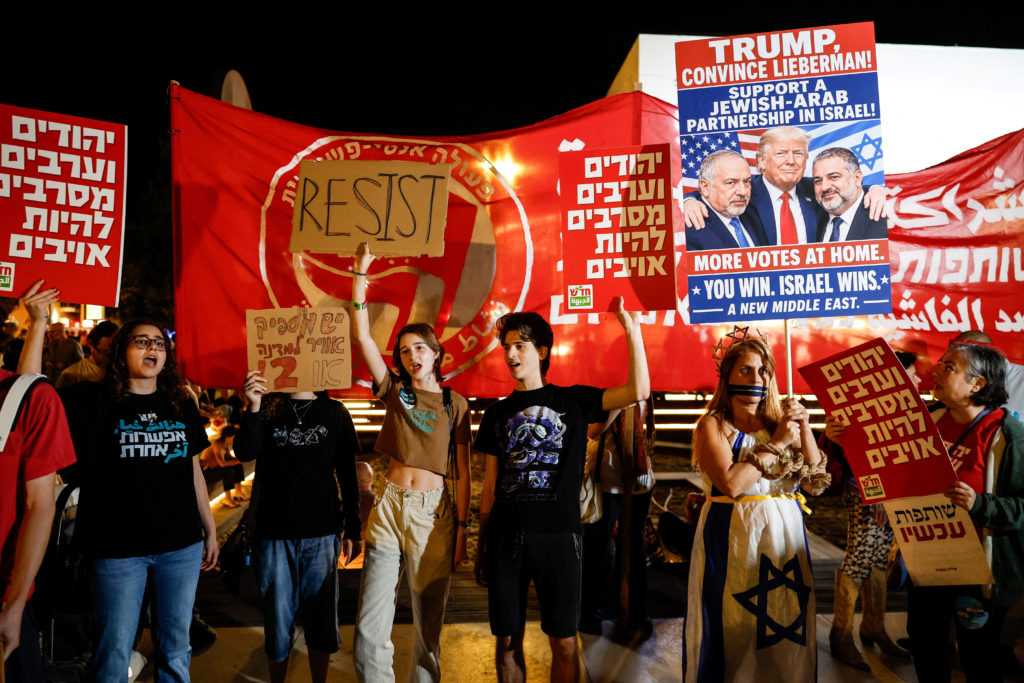 PBS NewsHourThis piece reads center-left
“Netanyahu claimed Arabs stole vote”
FramingPresents Netanyahu's claim directly in the headline rather than as an allegation or disputed assertion—the phrasing 'claimed' signals skepticism, whereas other outlets treat the investigation as a factual process without embedding it in Netanyahu's narrative.
Read the original- YnetnewsThis piece reads centerHeadline changed after publishing
Headline changed from: Israel election results: Netanyahu bloc at 53 seats, Eisenkot bloc at 48 as nearly all votes counted. To: Israel election results: Netanyahu bloc drops to 54 seats as Arab parties rise to 18.
- Who is namedNo longer names “Eisenkot”.
- Who is namedNow names “Arab”.
- FigureA figure changed: “53”, “48” became “54”, “18”.
“Netanyahu's bloc stands at 54, Eisenkot's at 48”
Read the original - The Straits TimesThis piece reads center
“inquiry into irregularities will not undermine result”
Read the original - RealClearPoliticsnot ratedRead the original
 UnHerdThis piece reads center-right
“Will Arabs be Israel's kingmakers?”
Word choiceFrames Arab parties' potential coalition role as a question of their power over Israeli governance, emphasizing their leverage and influence, while other outlets discuss coalition mathematics more neutrally.
Read the original
Placements are generated by an AI model from each article’s own headline and summary, and every quotation above is checked to be a real substring of that article before it is published. How this is done
Prism is free and carries no advertising. Support it if it was useful.