California Governor Newsom signs executive order to explore AI 'kill switch'
Reported by
A dot shows how that piece reads — Prism rates articles, not outlets, and shows the words behind each placement below. No dot means the piece isn’t rated. How the ratings work

What happened
The account the coverage agrees on, with contested figures attributed rather than asserted. This is not one of the five framings below — it is the ground they all stand on.
California Gov. Gavin Newsom signed an executive order on September 18 directing state agencies to explore AI safety regulations and report by November 16 on whether a 'kill switch'—a mechanism to halt malfunctioning AI systems—is feasible. The order accelerates third-party oversight of AI safety and calls for stronger regulation of frontier AI models. Newsom cited federal inaction on AI regulation as the reason for state-level action.
How the spectrum reads this story
The same event, summarised as five points on the political spectrum would each tend to frame it. These are generated by an AI model and are a starting point, not the last word.
Left
Newsom's order represents a necessary but incomplete response to the existential dangers posed by unregulated AI development. While exploring a kill switch is welcome, the order stops short of imposing binding safety requirements or restricting AI deployment—it merely studies feasibility. Real protection requires treating AI like other powerful technologies: strict pre-deployment testing, mandatory auditing, and enforceable guardrails, not just state panels and federal appeals.
Center-left
The governor is right to act where Washington has failed. A kill switch mechanism and mandatory independent auditing address legitimate public concerns about frontier AI safety. The order properly balances innovation with caution: rather than banning technology, it establishes oversight structures and requires companies to demonstrate safety. This pragmatic approach—study what works, implement what proves necessary—shows how states can lead when federal gridlock prevents action.
Center
Newsom's move reflects real uncertainty about AI risks and federal capacity. A study of kill-switch feasibility is sensible: it gathers facts before overreaching. But the order also raises questions: will a state-level kill switch actually work if AI systems operate nationally? Will oversight requirements push companies out of California? Some urgency is warranted, yet premature mandates risk unintended consequences. The best path combines state experimentation with genuine federal-state coordination, not parallel regulation.
Center-right
While AI safety oversight has merit, this order exemplifies the regulatory overreach that stifles innovation. California is rushing ahead with vague mandates—a 'kill switch' is more rhetoric than policy—that could hamper development of beneficial AI applications. The governor should focus on enforcing existing laws rather than inventing new bureaucratic layers. Federal coordination matters; states acting unilaterally create compliance chaos. Companies need clarity and stability, not moving targets from Sacramento.
Right
This is performative governance masquerading as leadership. Newsom signed an order that explores a kill switch without actually implementing one, then uses the announcement to position himself for 2028. The real problem isn't insufficient regulation—it's government incompetence and overreach. California's history of tech regulation (privacy laws that burden small business, energy rules that raised costs) suggests state agencies lack the expertise to oversee cutting-edge AI. Market competition and transparency are better safeguards than another bureaucratic panel.
Hear two viewpoints debate it
Pick two viewpoints and Prism writes a short, six-turn exchange about this story in each one’s own voice — steel-manned, no winner declared. Each pairing is written once and then saved for every reader. The voices are AI syntheses of a tradition, not real people.
New pairing — Prism will write it now.
How each outlet covered it
Where Prism places each piece — not the outlet in general — with the words from that piece that put it there, and the photograph the outlet chose. Picking a photo is a framing decision too.
- Washington PostThis piece reads center-left
“pushing for an AI 'kill switch”
Word choiceUses 'pushing for' (active pursuit) where other outlets describe the order as directing a study or exploration of feasibility—it signals more aggressive action than the order actually mandates.
Read the original - CNBCThis piece reads center-left
“rein in AI 'before it's too late”
Word choiceThe phrase 'before it's too late' frames AI as an urgent, existential threat requiring immediate action, whereas most outlets describe the order more neutrally as establishing oversight or exploring feasibility.
Read the original  The Irish TimesThis piece reads center-left
“wants AI 'kill switch' to rein in tech industry”
Read the original- LA TimesThis piece reads center
“ordered the formation of a panel to come up with safety regulations”
Read the original 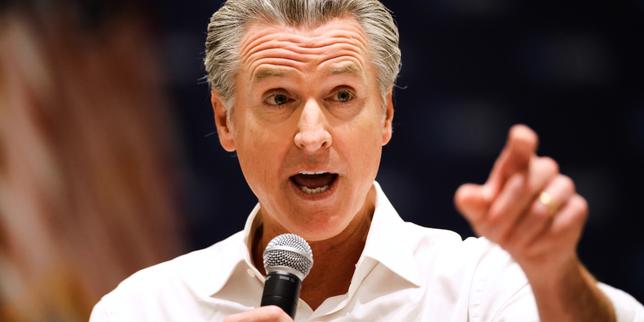 Le MondeThis piece reads center
“directs state agencies to report by November 16 on whether one is feasible”
What's left outExplicitly clarifies in the snippet that the order does not implement a kill switch but directs a study, a precision omitted from most other outlets' headlines and opening framing.
Read the original- Politico EuropeThis piece reads center
“comes amid national concerns about the potential existential dangers”
Read the original  Fox BusinessThis piece reads center-right
“advances AI 'kill switch' mandate”
Word choiceUses 'mandate' to describe an order that actually directs agencies to study and report on feasibility—overstates the binding force of what Newsom signed.
Read the original
Placements are generated by an AI model from each article’s own headline and summary, and every quotation above is checked to be a real substring of that article before it is published. How this is done
Prism is free and carries no advertising. Support it if it was useful.