Serbia's Aleksandar Vučić concedes defeat to student-led movement in parliamentary elections
Reported by
A dot shows how that piece reads — Prism rates articles, not outlets, and shows the words behind each placement below. No dot means the piece isn’t rated. How the ratings work

What happened
The account the coverage agrees on, with contested figures attributed rather than asserted. This is not one of the five framings below — it is the ground they all stand on.
Aleksandar Vučić, Serbia's president and leader of the Serbian Progressive Party, conceded defeat in snap parliamentary elections on Sunday after 14 years in power. A student-led movement, the Student List, won the election with over 2 million votes in the country of 6.5 million, achieving an absolute majority in parliament according to projections. The snap election followed nearly two years of student-led demonstrations against corruption and authoritarianism, triggered partly by deaths in a train station canopy collapse. Turnout reached nearly 70%, the highest since Yugoslavia's breakup in 1992.
How the spectrum reads this story
The same event, summarised as five points on the political spectrum would each tend to frame it. These are generated by an AI model and are a starting point, not the last word.
Left
Serbia's youth have dismantled an authoritarian regime through sustained grassroots organizing. Vučić's 14-year rule exemplified how far-right parties consolidate power through nationalist rhetoric and democratic erosion. The Student List's victory proves that popular movements can overcome entrenched elites, even when those elites control state machinery. This is a template for challenging authoritarian rule anywhere: organize locally, name corruption and democratic backsliding, and persist. The challenge now is whether a new government can actually deliver institutional reform or whether elite capture will reassert itself.
No article in this story reads this way. This is how the position tends to frame events like it — written by a model, not quoted from anyone.
Center-left
Serbia's voters rejected Vučić's model of centralized strongman rule in favor of democratic renewal. A student-led movement channeled public anger at corruption and democratic decline into electoral victory through two years of sustained activism. The snap election and record turnout suggest citizens want transparent, accountable governance and rule of law. This represents a significant break from the previous government's approach, though whether the Student List can deliver meaningful institutional reform and anti-corruption measures will determine whether this transition produces lasting change or remains largely symbolic.
Drawn from 5 articles placed here, below.
Center
Serbia's election reflects public exhaustion with Vučić's 14-year tenure and his government's real or perceived failures on corruption and democracy. A student-led opposition succeeded in channeling discontent into electoral victory, achieved record turnout, and appears to have won a parliamentary majority. The snap election Vučić called backfired tactically. Whether this represents genuine democratic renewal or simply a change of faces depends on what the Student List actually does in office, how quickly they address the grievances that mobilized voters, and whether institutional checks and reforms can prevent new forms of power concentration.
Drawn from 9 articles placed here, below.
Center-right
Serbian voters chose change after 14 years of Vučić's rule, signaling desire for new leadership and policy direction. A student-led movement capitalized on public concern about corruption and democratic governance to win a clear electoral mandate. The high turnout and decisive result suggest public engagement with the democratic process. Questions remain about whether the Student List has a coherent governing platform, how they will handle Serbia's complex position balancing ties to Russia and the West, and whether they can deliver on anti-corruption promises without overreaching. Continuity in foreign policy and economic management will matter alongside democratic reform.
Drawn from 1 article placed here, below.
Right
After 14 years leading Serbia, Vučić conceded electoral defeat to a student-led movement in snap parliamentary elections. The Student List won majority support with pledges to fight corruption and restore democratic norms. The outcome reflects voter preference for new leadership, though questions persist about the movement's governing capacity, policy platform, and ability to maintain Serbia's strategic balance between Russia and Western institutions. The foreign policy implications of this transition—particularly regarding Serbia's relationship with NATO and Russia—remain to be seen.
No article in this story reads this way. This is how the position tends to frame events like it — written by a model, not quoted from anyone.
Hear two viewpoints debate it
Pick two viewpoints and Prism writes a short, six-turn exchange about this story in each one’s own voice — steel-manned, no winner declared. Each pairing is written once and then saved for every reader. The voices are AI syntheses of a tradition, not real people.
New pairing — Prism will write it now.
How each outlet covered it
Where Prism places each piece — not the outlet in general — with the words from that piece that put it there, and the photograph the outlet chose. Picking a photo is a framing decision too.
- Axiosnot rated
What's left outFrames the election's significance primarily through U.S. interests and potential impact on American foreign relations, where other outlets emphasize the domestic Serbian political shift itself.
Read the original  The i Papernot ratedRead the original
 The Irish TimesThis piece reads center-left
“Seismic political shift as youth movement topples right-wing party”
Read the original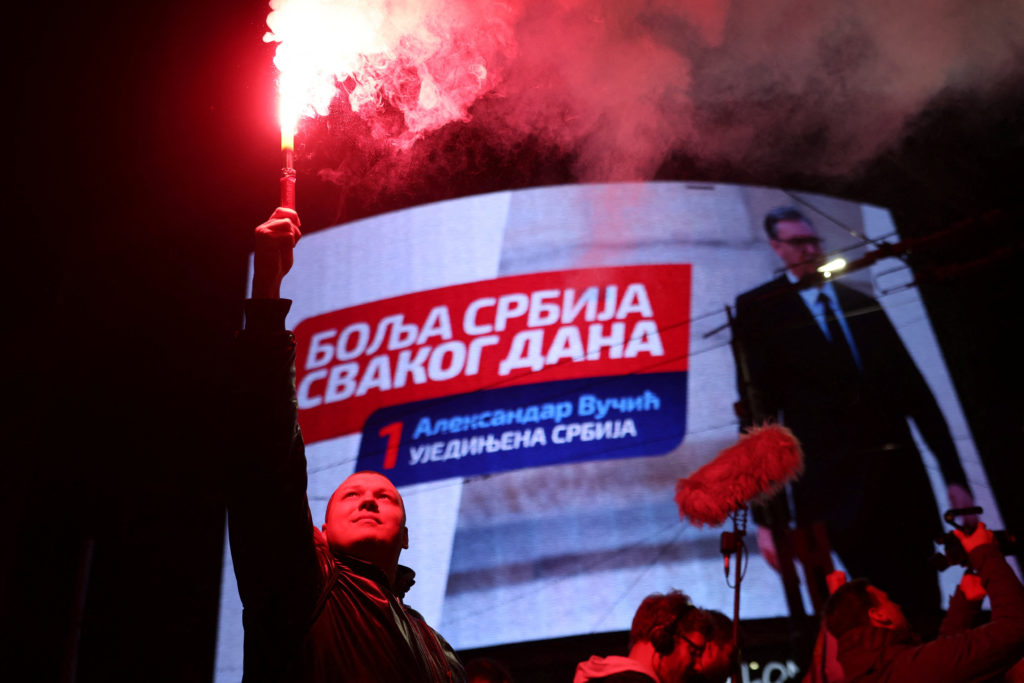 PBS NewsHourThis piece reads center-left
“endorsed by Russian President Vladimir Putin”
Read the original- BloombergThis piece reads center-left
“Putin-Like Gamble Backfires”
Word choiceCharacterizes Vučić's strategy as Putin-like and explicitly frames the election as a reversal of that approach, suggesting a parallel to authoritarian governance more directly than other outlets.
Read the original - StuffThis piece reads center-left
“Putin ally concedes defeat”
Word choiceOpens with Vučić labeled as a Putin ally rather than simply as Serbia's leader, foregrounding his foreign alignment over his domestic role.
Read the original 
 France 24not ratedRead the original
- Politico EuropeThis piece reads center
“lost in a landslide to a protest-backed student movement”
Read the original - CBS NewsThis piece reads center
“led with virtually absolute power for 14 years”
FramingIncludes Vučić's characterization of the movement as foreign-led in the main snippet, while most other outlets report only that demonstrations occurred and he lost.
Read the original  Financial TimesThis piece reads center
“dramatic fall from power for strongman nationalist leader”
Read the original Israel National NewsThis piece reads center-right
“Pro-Israel President Vucic”
Word choiceIdentifies Vučić by his Israel stance in the headline where no other outlet does, emphasizing a characteristic relevant to that outlet's readership rather than to the election itself.
Read the original


Placements are generated by an AI model from each article’s own headline and summary, and every quotation above is checked to be a real substring of that article before it is published. How this is done
Prism is free and carries no advertising. Support it if it was useful.